A decade ago today, June 23rd, 2016, 52% of the British electorate voted to leave the European Union. It was a massively consequential moment for the U.K.’s economy and political scene, and kicked off one of the most tumultuous decades in the country’s recent history.
Starmer’s resignation paves the way to the premiership for Andy Burnham, the former mayor of Greater Manchester. If chosen by Labour, Burnham will become the U.K.’s seventh prime minister to have held office in the decade since Britons voted on the country’s new trajectory.
The years since have been a time of volatility unmatched in the U.K.’s recent political history, compounded by economic malaise and deep-rooted societal changes that will likely hold repercussions deep into the next decade and beyond.
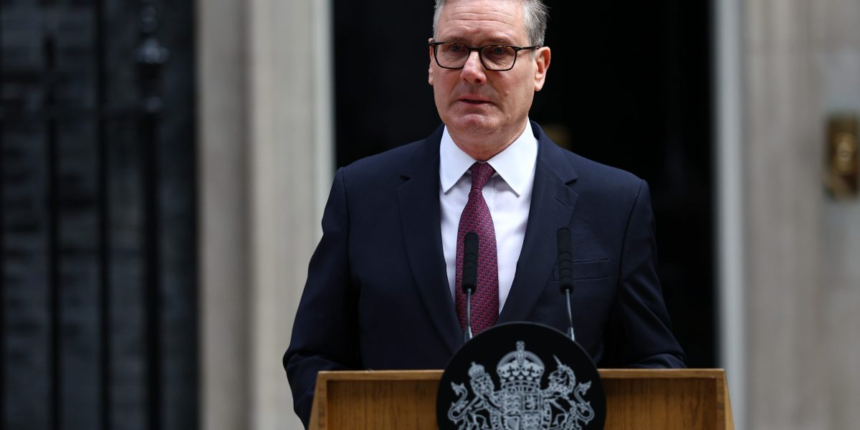
With Starmer’s announcement, the outgoing prime minister brought a fittingly turbulent end to a chaotic decade, one that began with a similar strain of political upheaval.
Six prime ministers have taken office at 10 Downing Street since the referendum, none of whom have lasted long enough to bury the political instability Brexit unleashed.
And now Starmer himself is out less than two years into a five-year mandate, his Labour government undone by a local-election drubbing and a right-wing populist rise that has scrambled the country’s two-party map.
Each departure was tainted by its own cocktail mix of political poison: failed attempts to get Brexit over the line, scandals, economic headwinds, or landslide defeats. The past 10 years have hardly left U.K. politics on more stable footing compared to the day Britons voted to leave, though even if voters might have grown accustomed to the revolving door at Downing Street, the economic repercussions of the country’s volatility are just beginning to be laid bare.
While Westminster cycled through leaders, Britain’s underlying population accelerated into a slide that might prove almost impossible to reverse.
Between 2024 and 2034, the ONS projects 6.4 million births against 6.85 million deaths—a natural shortfall of roughly 450,000 people over the coming decade or so. Beginning in 2026, net migration is the only thing keeping the population growing at all, and even that is no longer a certainty. The latest ONS projections forecast the U.K.’s population to grow by 1.7 million people by 2034, almost half the increase estimated last year, largely due to declining net migration.
“Our latest projections indicate slower population growth than previously projected,”
But the economic consequences will be felt far earlier. The number of Britons of pensionable age is set to grow by 1.8 million over the next decade, even as the number of children falls by 1.6 million, shrinking the future tax base needed to support a larger pension and healthcare bill.
It’s a fiscal squeeze with no easy political fix, regardless of who might be sitting in Downing Street.
Over the past decade, Brexit has cost the U.K. economy between 6% and 8% of its GDP, the authors found from an analysis of Bank of England data. In those 10 years, investment fell 12% to 13%, employment decreased 3% to 4%, and productivity also declined between 3% and 4%.
Those losses have compounded over time and are directly tied to the political instability that has plagued the U.K. since the vote. The authors estimated that around half of GDP loss was attributable to the years of elevated policy uncertainty. Brexit generated unease that firms rated as one of their top three concerns for nearly five years after the vote, only moderating somewhat in 2021 once a new EU trade deal took effect. The remainder of the lost growth came down to higher costs imposed by more cumbersome trade restrictions.
Ten years out to the day from that historic vote, the steps of Number 10 are increasingly well-trodden, while the U.K. has become saddled with a population now tilted toward old age and an economy that’s smaller than it would otherwise have been. The vote may have taken place over a single day, but its bill is still adding up.