Conditions for the fragile ceasefire between the U.S. and Iran deteriorated on Saturday as the Strait of Hormuz became more of a combat zone again, closing off ship traffic and keeping the global economy mired in an energy crisis.
The Islamic Revolutionary Guard Corps warned ships in the Persian Gulf that vessels of any type or nationality will be destroyed if they try to cross the narrow waterway.
That came after several ships reported coming under attack from projectiles and small boats on Saturday as the regime asserted its control over strait after Iran’s foreign minister and President Donald Trump declared it fully open on Friday.
Iran has said the strait will not reopen until the U.S. lifts its naval blockade, which Trump said will remain in place until a deal is reached.
Meanwhile, the Pentagon announced on Thursday that the interdiction of ships would expand beyond those entering or leaving Iranian ports and will now include “any Iranian-flagged vessel or any vessel attempting to provide material support to Iran.”
That also means so-called dark fleet ships that carry Iranian oil and evade sanctions, and Joint Chiefs of Staff Chairman Gen. Dan Caine said U.S. Indo-Pacific Command will help implement the wider dragnet.
Navy ships in the Central Command area of operations have already forced dozens of ships to turn around after they attempted to cross the strait. So far, none have been able to avoid the blockade in the Middle East.
Elsewhere, Lloyd’s List Intelligence said at least five Iran-linked tankers heading to Malaysia have changed course to avoid the U.S. Navy.
By preparing to board ships, the Pentagon is now looking to take physical control of Iran-linked vessels around the world, including those outside the Persian Gulf carrying oil or arms for the Iranian regime, the Journal reported.
Casting a net outside the immediate vicinity of the Gulf could prevent Iran from generating oil revenue from ships that were already at sea when the U.S. imposed its blockade. Iran also has oil in “floating storage” sitting in tankers that could get caught up in campaign as well.
By squeezing the Iranian economy further, including a top source of money for the IRGC, the Trump administration seeks to facilitate a peace deal.
The U.S. military has different ways it can board ships. The Navy employs visit, board, search, and seizure teams for routine missions, while SEAL commandos are used in high-risk operations.
The Coast Guard also boards ships and was instrumental in the interdiction of vessels connected to Venezuela in the Atlantic and Indian oceans.
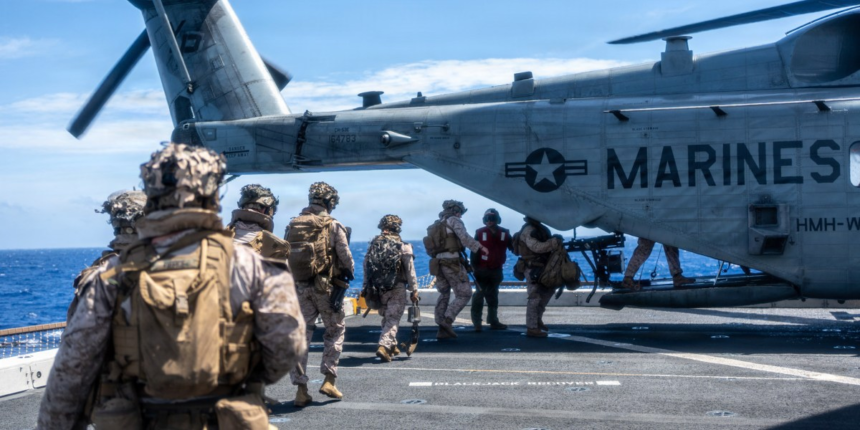
The Marine Corps, which deploys onboard Navy amphibious assault ships, also has maritime raid forces that are typically used in hostile boarding situations.
In fact, the 31st Marine Expeditionary Unit has been in the Middle East for a few weeks and recently practiced maritime raid operations, including at night.
At the same time, the 11th Marine Expeditionary Unit is en route to the Mideast but is currently in the Indo-Pacific area of operations, where the Pentagon said the wider naval crackdown could reach.
Each MEU consists of three amphibious assault ships and about 2,200-2,500 Marines. Trump hasn’t ruled out sending in ground troops to seize Iranian islands and reopen the Strait of Hormuz, but such a mission would present various risks.
For example, even after seizing an island, ground troops would be vulnerable to attack from Iranian ballistic missiles and drones, which have overwhelmed U.S. air defenses during the war.