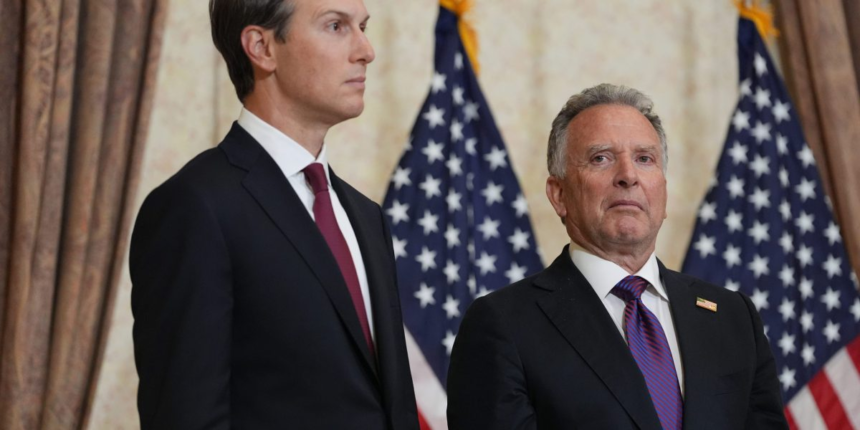
Officials have not specified when President Donald Trump’s envoys Steve Witkoff and Jared Kushner, who are expected to lead the U.S. negotiation team, are due to arrive. The White House declined to comment on Saturday.
On Saturday, Iran resumed commercial flights from Tehran’s international airport for the first time since the conflict with the U.S. and Israel began about two months ago. Flights were scheduled to depart for Istanbul, Oman’s capital of Muscat and the Saudi city of Medina, according to Iran’s state-run television. Iran partly reopened its airspace earlier this month due to the ceasefire.
Iran’s Foreign Minister Abbas Araghchi meanwhile met with the Pakistan military’s chief of staff and Prime Minister Shehbaz Sharif. Araghchi wrote on Telegram that they spoke about regional developments, including Iran’s red lines for negotiations. Araghchi didn’t offer further details, but said Tehran would continue engaging with Pakistan’s mediation efforts “until a result is achieved.”
Islamabad, where weeklong security restrictions have disrupted daily life in the capital, was in near-lockdown early Saturday ahead of the expected talks. Residents struggled to commute even short distances due to the now routine checkpoints, road closures and diversions.
The usually busy arteries leading to the airport and the heavily fortified Red Zone were largely deserted Saturday, with movement tightly restricted. Security forces — including troops, paramilitary commandos and police — maintained a strong presence at key intersections, especially near the airport, while helicopters circled overhead.
The White House said Friday that Trump was sending Witkoff and Kushner to meet with Araghchi. But shortly after Iran’s top diplomat arrived in Islamabad, his ministry said any talks would be indirect and that Pakistani officials would convey messages between the two sides.
“We’ve certainly seen some progress from the Iranian side in the last couple of days,” Leavitt said. She did not offer any details about what U.S. officials were hearing.
He first announced a 60-day waiver in March, hoping to stabilize energy prices and ease oil and gas shipments to the U.S. following the effective closure of the Strait of Hormuz, a strategic waterway through which a fifth of the world’s oil passes in peacetime.
Germany’s Defense Minister Boris Pistorius announced Saturday that the country was sending minesweeper ships to the Mediterranean to help remove Iranian mines from the Strait of Hormuz once hostilities end.
Since the war began, at least 3,375 people have been killed in Iran, and more than 2,490 people in Lebanon, where new fighting between Israel and the Iran-backed militant group Hezbollah broke out two days after the Iran war started, according to authorities.
Additionally, 23 people were killed in Israel and more than a dozen in Gulf Arab states. Fifteen Israeli soldiers in Lebanon and 13 U.S. service members throughout the region have been killed.
The U.N. peacekeeping force in southern Lebanon has also sustained casualties. An Indonesian peacekeeper died of wounds sustained in an attack on his base on March 29, raising to six — four Indonesians and two French — the number of force members killed since the war erupted, UNIFIL said Friday.
In a video released by his office Friday, Israeli Prime Minister Benjamin Netanyahu hailed “a process to achieve a historic peace between Israel and Lebanon.”