Chinese leader Xi Jinping told Asia-Pacific leaders on Friday that his country would help to defend global free trade at an annual economic regional forum snubbed by U.S. President Donald Trump.
This year’s two-day APEC summit has been heavily overshadowed by the Trump-Xi meeting that was arranged on the sidelines.
“The more turbulent the times, the more we must work together,” Xi said during APEC’s opening session. “The world is undergoing a period of rapid change, with the international situation becoming increasingly complex and volatile.”
Xi called for maintaining supply chain stability, in a riposte to U.S. efforts to decouple its supply chains from China. He also expressed hopes to work with other countries to expand cooperation in green industries and clean energy.
In written remarks sent to a CEO summit held in conjunction with APEC, Xi said China was open for investment and would uphold the multilateral trading system.
“Facts have proven that whoever gains a foothold in the Chinese market will be able to seize the critical opportunity in increasingly fierce international competition,” Xi wrote. “Investing in China is investing in the future.”
U.S. Secretary of the Treasury Scott Bessent, who attended the summit on Trump’s behalf, said a U.S. move to rebalance its trade relationships would ensure that “each country operates on fair and reciprocal terms.” He added that the U.S. is “investing with its trading partners to build resilient production networks that reduce dependence on vulnerable sectors.”
It’s Xi’s first visit to South Korea in 11 years.
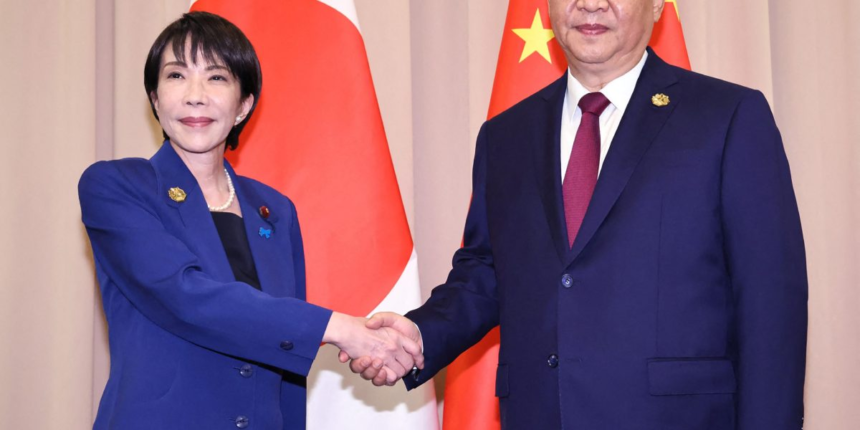
In his meeting with Takaichi, Xi said he hopes the two countries would commit to building a constructive and stable relationship “fit for the new era.” Takaichi expressed hopes to ease what she called “a variety of” challenges facing the two countries. She said she also hopes to deepen her personal relationship with Xi.
Leaders and other representatives from 21 Asia-Pacific Rim economies are attending the APEC meeting to discuss how to promote economic cooperation and tackle shared challenges. Opening the summit as chair, Lee called for greater cooperation and solidarity.
“It’s obvious that we can’t always stand on the same side, as our national interests are at stake. But we can join together for the ultimate goal of shared prosperity,” Lee said. “I hope we will have candid and constructive discussions on how we can achieve APEC’s vision in the face of the new challenge of a rapidly changing international economic environment.”
Despite Trump’s optimism after a 100-minute meeting with Xi, there continues to be the potential for major tensions between the countries, with both seeking dominant places in manufacturing and developing emerging technologies such as artificial intelligence.
“It is certainly a contribution to bring the leaders of the two largest economies together for a meeting where they agreed to withdraw their most extreme tariff and export control threats. As a result, worst-case outcomes for global trade were averted,” said Leif-Eric Easley, professor of international studies at Ewha Womans University in Seoul.
“However, APEC is meant to be more than a venue for a trade war truce,” Easley said. “Greater multilateral efforts are needed to address the region’s most pressing economic challenges, including resisting costly and destabilizing protectionism, harmonizing regulations for sustainable trade, and coordinating standards for digital innovation.”
South Korean Foreign Minister Cho Hyun said last week that issuing a joint statement strongly endorsing free trade would be unlikely because of differing positions among APEC members. He instead anticipated a broader declaration emphasizing peace and prosperity in the region.
As the host nation, South Korea placed a priority on discussing AI cooperation and demographic challenges during the summit.
___
Wu reported from Taipei, Taiwan. Associated Press writer Mari Yamaguchi in Tokyo contributed to this report.