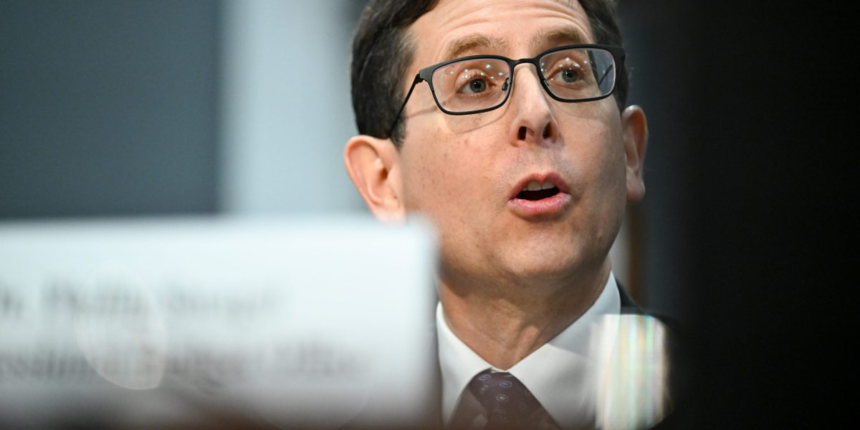
Phillip Swagel is an optimist, both by nature and when he looks at the U.S. economy.
This fact is perhaps at odds with what one might assume: Swagel is the director of the Congressional Budget Office (CBO), the nonpartisan agency that offers independent budgetary and economic analysis to Congress.
Very often—an inevitable occupational hazard—the subject of national debt, and the interest the U.S. Treasury pays to maintain it, is its central focus. The numbers are eye-watering: Public debt stands at more than $39 trillion. The interest expense on that borrowing now exceeds $1 trillion a year. Indeed, the latest budget update from the CBO highlights that the government—according to preliminary estimates—paid out nearly $530 billion between October 2025, when the fiscal year starts, and March 2026. This equates to more than $88 billion in interest payments a month, or more than $22 billion a week.
The CBO’s figures are routinely cited by policymakers, think tanks, and lobbyists as alarming evidence that the U.S. needs to find a more sustainable fiscal path or risk dire straits.
Swagel doesn’t subscribe to the notion that the U.S. will face a crisis of its own making. His justification is simple: He was at the Treasury during the 2008 financial crisis, and joined the CBO months before the COVID pandemic began. He has watched as the U.S. economy, seemingly against all odds, has clawed its way out of economic crises before.
That’s not to say Swagel isn’t a staunch advocate of setting the U.S. on a more sustainable fiscal path. Rather, he trusts the people in power to do so when the time comes.
On the other hand, optimistic economists suggest that, despite the value of the debt, it’s not actually an issue: The bond market is holding steady, indicating a reliable market of buyers. Likewise, the U.S.’s own central bank buys huge swaths of the debt, meaning, in the simplest of layman’s terms, the economy can essentially print its own money. There are holes in this argument, not least the fact that Fed chairman nominee Kevin Warsh has suggested he would like to reduce the Fed’s balance sheet and may therefore be less inclined to finance borrowing.
Swagel’s positive outlook doesn’t rely on the argument that a crisis hasn’t happened yet, so therefore it never will: “[My optimism] is rooted in my experience,” Swagel tells Fortune in an exclusive interview in Washington, D.C. “First being at Treasury during the financial crisis and seeing very difficult times and the country coming together with an effective response—not saying it’s perfect, lots of controversy—but it was effective.”
He continued, “The second thing is policymakers are smart, they’re thoughtful. Interacting with members of Congress makes me optimistic. I know you read about all the squabbles…I’m completely aware of this, but the policymakers that are thinking about these things are thoughtful and effective. Not necessarily always effective at passing legislation, but that’s part of our political system. It was set up to make it difficult to pass legislation.”
Swagel’s optimism that Congress will be pushed into action will be tested sooner rather than later, likely at some point in the next six years, he told Fortune. This is partly due to the fact that, according to the Committee for a Responsible Federal Budget (CRFB), both Social Security and Medicare will become insolvent within that time period.
“Making progress to address the fiscal trajectory would be a positive for the U.S. economy,” Swagel said. “Credible steps would lead to lower interest rates that would make the subsequent adjustment easier; there is a reward to virtue. It’s a positive thing. We can’t go on [with] the scolding narrative. My sense is that members of Congress understand the fiscal situation. It’s not that every single one has looked at our one-pager of numbers and understands the debt to the third decimal point, but they understand something needs to be done.
“It doesn’t have to be done immediately, but at some point reasonably soon.”
Swagel is of the opinion that bond investors haven’t increased risk premiums not because they’re not worried about a fiscal crisis, but because they have priced in preventative action from Congress—in his mind “a vote of confidence that my optimism is not misplaced.”
“As a country, we face up to these problems. It’s not happening now, I’m not sure it’s going to happen in the rest of this year or even the next year, or the next two years. But we will face up to it, and the market in some sense expects us to, because otherwise interest rates would be higher,” he explained.
The role of the CBO, to some extent, is to provide policymakers with their options if and when they do choose to take action on federal deficits. It’s a menu not unlike the Cheesecake Factory’s, Swagel says: large, inclusive of a range of modifications and options, and delivered without judgment.
“Right now it’s maybe a pick three, and you’re looking at a six- or seven-course menu,” joked Caleb Quakenbush, director of fiscal policy at the Bipartisan Policy Center, in an interview with Fortune. “The longer you delay, the more you’re gonna have to add to your tab, and those options become more expensive.”
“Growth needs to be a part of it, but it’s sort of a vicious cycle. The longer we delay, the more debt we have, the slower growth is going to be. The more we get this under control, I think the greater optimism there is, interest rates go down, more growth comes from that. It’s sort of a virtuous or vicious cycle depending on your policy response.”