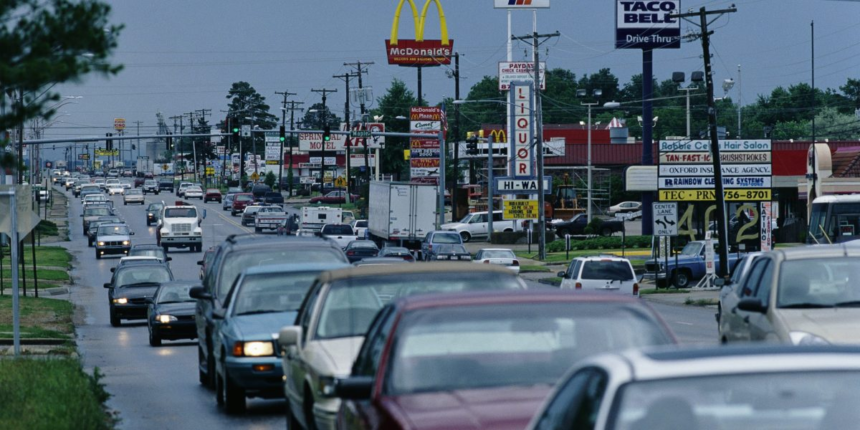
The memes are almost everywhere: one of the straight-from-Italy Furio disgusted while looking out of a cab window at the standard American road, complete with fast food chains and struggling shoe stores and nail salons that make up America’s strip malls. Perhaps you’ve seen another Sopranos meme, of the show’s namesake similarly sitting in a car that picked him up at Newark Airport, somberly looking out onto the fuel and wastewater treatment facilities that dot the New Jersey Turnpike; a scene juxtaposed earlier with his family’s idyllic trip in Italy. Tony Soprano’s America, rendered in all its asphalt glory.
The United States’ infrastructure, to say the least, leaves much to be desired. The country spent years campaigning for the right to host the world’s most-watched sporting event, promising FIFA that it was ready. And with an expected 5 million visitors leaving their home countries—complete with high-speed rail, free or low-cost reliable transportation, and livable yet unplanned walkable cities—to attend the World Cup next month, American host cities are scrambling to sustain that increased demand on their cities and are finally questioning why the average American city pales in comparison to that of almost every other World Cup host city. With America’s top engineers giving the country’s infrastructure a C rating (which, for the first time ever, was an improvement), engineers and infrastructure experts are hoping this tournament will be a wakeup call to really plan a livable city and improve the way we get around.
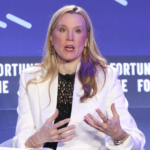
“We’re not investing enough in infrastructure. We’re basically playing catch up to just try to get to what’s called the state of good repair,” said Marsha Anderson Bomar, president of the American Society of Civil Engineers (ASCE), the country’s oldest national engineering organization, representing more than 160,000 civil engineers.
“And so if that’s the majority of what you’re doing, then you’re not really getting ahead of the curve with respect to the actual infrastructure needs.”
The irony is the school bus is actually an improvement.
NJ Transit initially announced round-trip rail tickets on match days would cost $150, a markup of more than 1,000% over the standard $12.90 fare. After public backlash, the price dropped to $105, then $98. FIFA president Gianni Infantino called this, among other similar practices seen in the other U.S. host cities, typical of the American sports landscape. “You cannot go to watch in the US, a college game, not even speaking about a top professional game of a certain level, for less than $300,” Infantino said at the Milken Institute Global Conference. “And this is the World Cup.”
NJ Transit CEO Kris Kolluri insisted the pricing wasn’t exploitative: “We’re literally trying to recoup our costs.” Should that be true, the transit agency servicing the World Cup final is saying that moving people to a stadium is so expensive for them, a $98 train ticket is the break-even.
Don’t want the train or the school bus? There’s zero on-site parking at MetLife. Fans who drive must reserve a spot at the nearby American Dream Mall at $225 per game, then walk across a pedestrian bridge. In Miami, parking at Hard Rock Stadium has peaked at nearly $250. And for deep pockets? Helicopter rides from Manhattan to Teterboro Airport, which is still four miles from MetLife, start at $5,700 round-trip. In Boston, Blue Hill Helicopters is charging up to $30,000 for a group of eight to fly to a small airport that’s still nine miles from Gillette Stadium, at which point you get into a black car and sit in the same traffic as everyone else.
“There’s really no single category where we’re investing enough. The only places where it’s a little bit better is, for example, on the railroads, because it’s a private investment, so there’s a profit motive for investing in the rail infrastructure. Because the more capacity they have, the better the tracks they have, the more likely it is that they will make more money doing their business,” said Anderson Bomar.
She said this is very common for infrastructure in the U.S. where the question of private vs. public funding is top of mind for such major projects, and it’s not specific to just the World Cup. It’s not at all a shock that private companies are offering helicopter rides or elite car service, just as it’s not a shock that public transportation agencies are fighting for federal, state, and city funding just to fix an existing issue, instead of building something new.
“On the public side, clearly we don’t have that kind of motivation for investing in infrastructure,” said Anderson Bomer, who in addition to being the ASCE’s president and a transportation engineer also led her own firm through the 1996 Atlanta Olympic Games. “It’s the ASCE Code of Ethics: we’re all about public safety, health, and welfare. And when that’s your motivation, some people don’t necessarily buy into the level of investment that’s needed to really, truly provide adequate infrastructure, both in terms of quantity and quality of the infrastructure.”
“If you don’t have enough human capital to run your system, some of the cities are going to be stressed a little bit more with respect to having enough people,” she said, adding the logistics are compounded by the sheer amount of labor involved.
The good news is not every American host city is price gouging. Los Angeles announced a round-trip transit fare of $3.50. Philadelphia said there would be no fare increases at all, with costs covered by a federal grant. Houston and Atlanta are keeping standard fares.
New Jersey Governor Mikie Sherrill pushed back on FIFA’s refusal to help offset transportation costs, pointing to the organization’s projected $11 billion in tournament revenue. FIFA’s position? The contracts it signed in 2023 with the 16 host cities (Atlanta, Boston, Dallas, Houston, Kansas City, Los Angeles, Miami, New York, Philadelphia, San Francisco, Seattle in the U.S.; and Mexico City, Guadalajara, and Monterrey in Mexico and Toronto and Vancouver in Canada) clearly stated the governing body wouldn’t be paying.
Maybe those visiting the United States will benefit from that very American market that Infantino pointed to. Anderson Bomer said the one positive she can see from the convergence and lack of transportation alternatives is an increase of micromodal transportation options. “These are the different markets where the events are going to be held. The scooters and bikes should try to capitalize on that market. They’re in it to make money, they see a huge opportunity if they bring in a lot of micromobility assets. The transit systems are going to do their best to be as functional and reliable, and have as much capacity, but the transit agencies, particularly on the bus side, they’re struggling with having enough bus drivers.”
In March 2025, ASCE released its quadrennial infrastructure report card, issuing the nation a C rating, its highest grade since the report began in 1998. Public transit got a D, tied with stormwater for the lowest grade of any category. The ASCE projects a $152 billion funding gap for transit alone between 2024 and 2033, inside a $3.7 trillion overall infrastructure gap.
She said the World Cup presents a fundamentally different challenge than events like the Olympics. “With the Olympics, the way that people moved was a little bit more predictable,” she said. “With the World Cup, there’s so much less of a definitive pattern. How many people are coming to be in the city who don’t even have tickets but want to be there for the vibe of it all? People are going to be everywhere.”
For the 1996 Atlanta Olympics, the city drew a circle on the map: inside it, no parking. Buses and drivers were brought in from across the country. She hasn’t seen that magnitude of effort from any World Cup host city. “The cities are not building a lot of new infrastructure,” she said. “The kinds of things being done for the World Cup are more about managing crowds, about entertaining crowds so they stay calm and engaged.”
Visitors shouldn’t expect the gleaming, purpose-built experience of Qatar. “They’re not going to see shiny new things everywhere,” Anderson Bomar said. “I would think they would have a reasonably positive experience, but they’re not going to feel everything brand new like they did in Qatar.”
The bigger lesson, she argued, is that infrastructure investment shouldn’t be a scramble before a marquee event. “It shouldn’t be a race to the start date of the event every time. Taking care of people by having reasonable infrastructure—that should be a priority. It should be a way of life.”
Anderson Bomer was hopeful, however, that despite the country’s poor infrastructure rating, events like the World Cup and Olympics will be the impetus to building the adequate infrastructure the country needs. She pointed to Los Angeles’ growing rail connection network as one such example, saying the city has upheaved its rail system specifically for the 2028 Olympics, and some World Cup visitors will be able to use.
“The World Cup is benefiting from it, but it wasn’t the reason that they were doing, they were really much more focused on the Olympics that are coming in ‘28,” she said. “There’s there’s just not a lot of new infrastructure being created for World Cup.”
Millions of visitors from countries that made different choices are about to experience America’s infrastructure all at once. They’re going to land at LAX or Boston, JFK or Newark, sit in traffic on the New Jersey Turnpike, pay $98 for a rail ticket or board a yellow school bus, and arrive at a stadium in a parking lot that they weren’t allowed to walk to.
The 2026 World Cup is making America’s infrastructure problems impossible to ignore. And, as Anderson Bomer says, the school bus isn’t a transportation solution but a metaphor of a country improvising because it never built the thing it actually needed.
“I hope it leaves Americans more supportive of investing in infrastructure. That would be a good outcome.”