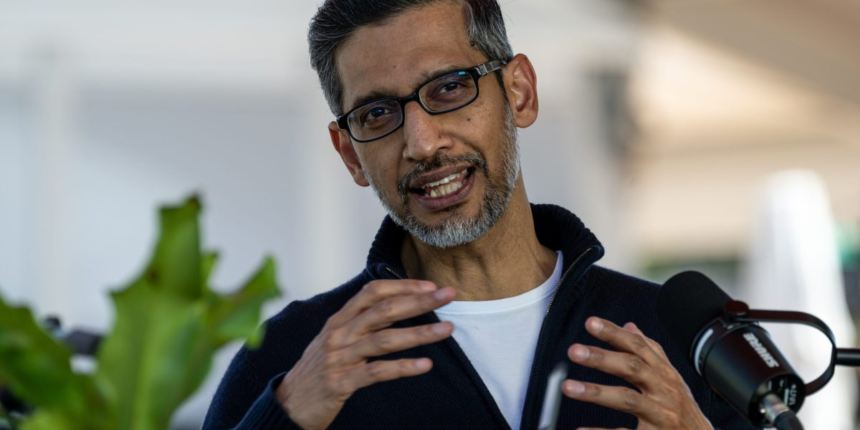
Sundar Pichai, CEO of Google parent company Alphabet, kicked off the Google I/O event praising AI’s role in helping students prep for exams and allowing artists and musicians to get into their “creative flow” as the world moves into the “agentic AI era.”
In a very visible sign of how important AI has become to the $4.7 trillion company, Google said it was redesigning the iconic search box that sits at the center of its sparse, all-white homepage. The company is enlarging the dimensions of the search box to expand and better accommodate the natural language queries that users can now make with AI. Users will also now be able to enlist AI agents for complex, ongoing research projects via the search box, ordering up custom reports for anything from apartment hunting to financial news.
The company’s capital expenditures—a cause of concern among some Wall Street investors—were projected behind Pichai on a giant screen as the the CEO described plans to spend between $180 billion and $190 billion this year, compared to $31 billion in 2022.
“We are taking a differentiated full stack approach to AI innovation, from our custom silicon and secure foundation to our world class research and models to our products and platforms that reach billions of people,” Pichai said.
Shares of Google fell roughly 2% in regular trading on Tuesday, amid a broader sell-off in the market.
Google unveiled new Gemini 3.5 models at the event on Tuesday, as well as a multimodal “Gemini Omni” system capable of generating video from mixed inputs like text, images, audio and video. Google said its AI Overviews now reach more than 2.5 billion users, while the Gemini app has grown to 900 million monthly active users, highlighting how the company can leverage its massive existing ecosystem to distribute new AI capabilities at global scale.
Pichai said Google now has 13 products that each have more than 1 billion users, and five products with more than 3 billion users.
Google introduced “Gemini Spark,” a “persistent agent—meaning the AI agent keeps working and retaining context over time, rather than just one back and forth—designed to complete tasks across products like Gmail, Docs, and Chrome. There is also the new “Docs Live,” a voice-driven document creation feature, and “Ask YouTube,” a conversational tool that can answer questions using specific moments from YouTube videos.
Google also plans to launch a “Universal Cart,” an AI-powered shopping cart that works across merchants and services, as well as new protocols designed to allow AI agents to securely make purchases on behalf of users. The company also previewed updates to its Antigravity AI coding and agent-development platform, new AI-generated visual experiences in Search, and broader integration of conversational AI throughout products including Maps, Gmail, and YouTube.