Higher education has a duty to “train the leaders of tomorrow,” says the head of one of Europe’s leading business schools, as geopolitics threatens to decouple economies, reverse globalization, and shake up the traditional pathways for talent and migration.
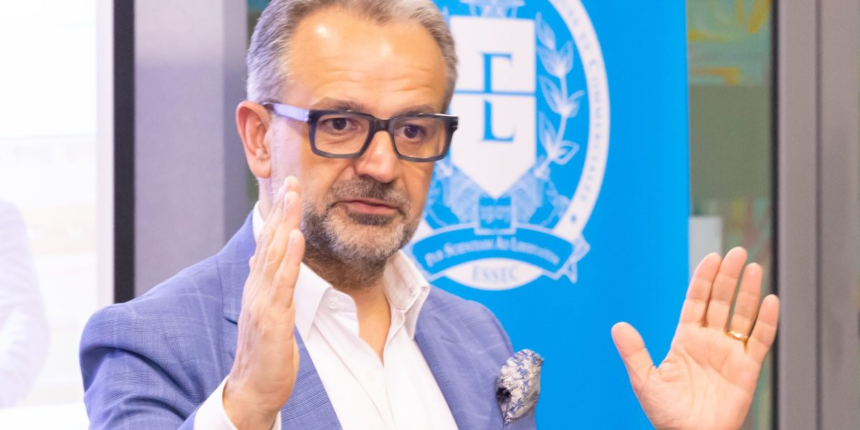
“[Globally,] there is this sense of fragmentation,” Vincenzo Vinzi, the dean of ESSEC Business School, tells Fortune.
As part of its signature program, students rotate through campuses in Morocco, Paris and Singapore. This builds leaders who are “multicultural,” Vinzi says—a trait he believes tomorrow’s leaders will need. “By attending classes in three continents, they are exposed to different experiences, cultures, ways of doing business, political environments and diversity as a whole,” he explains.
Forty percent of Essec’s students are international. The top nationalities represented at the school are Chinese, Indian and Moroccan students, Vinzi says. “I think that higher education—especially in business—has a societal role we need to fully undertake: to train the leaders of tomorrow,” he adds.
Essec’s MBA program is built around four key pillars: sustainability, human-centred AI, entrepreneurship and geopolitics. “You don’t have to be a politician to care about these topics. As a leader of a company, you need to understand the links between geopolitics, [current affairs] and business,” Vinzi explains.
The school takes a ‘transversal’ approach to the four focus areas, which means they are embedded within existing modules, rather than taught as separate classes. “It’s not a matter of simply adding courses on geopolitics, AI and sustainability, but understanding them within, for instance, the area of finance,” he explains.
Artificial intelligence is also reshaping higher education. Business schools are increasingly emphasizing activities which build not just technical skills, but also core human competencies.
“Our pedagogical model is enriched by experiences—it goes beyond what is taught in the classroom,” Vinzi said.
When asked on his hopes for ESSEC, Vinzi said he wants the school to be forward-thinking, and provide learning in specialized topics while bridging silos across disciplines. “We have to break silos between academia and civil society as a whole. I think it’s very important that higher education institutions are not ivory towers,” he said.
To achieve this, Vinzi emphasizes that research should not just be rigorous, but also relevant to society.
“At the end of the day, the mission of the business school is to have a positive impact on society—through the research of our professors, and the [work of] our graduates,” he said.