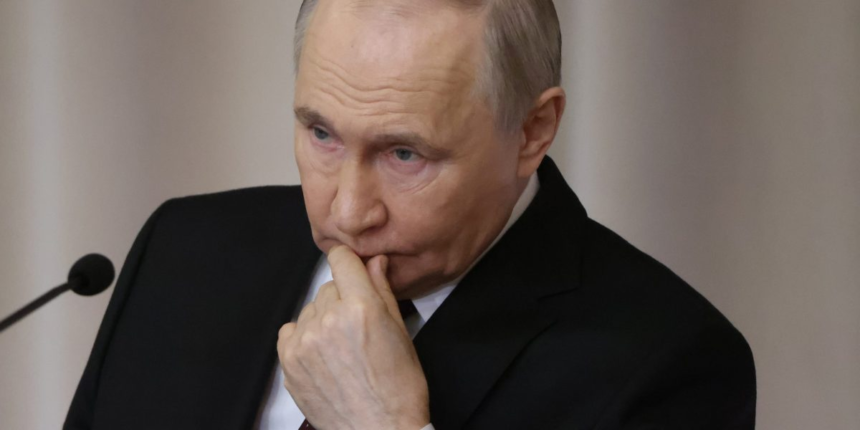
Vladimir Putin is losing the Russian people as the economy and his war machine go in reverse amid withering Ukrainian attacks.
After Russia launched a sudden invasion in 2022, Putin has not only failed to defeat Ukraine, his forces have been unable to take full control of the Donetsk region.
With Western military aid and innovations from Ukraine’s now-thriving domestic defense industry, Kyiv has weakened Russia’s economy and military.
Long-range drone strikes deep into Russian territory have damaged key oil-export hubs and “shadow fleet” tankers transporting sanctioned crude.
In a tacit acknowledgement of the heightened threat from Ukraine’s drones, the Kremlin said Wednesday it would dramatically scale back the annual Victory Day parade in Moscow’s Red Square later this month.
Meanwhile, ordinary Russians have grappled with high inflation caused by military mobilizations and defense production, as well as the Kremlin’s crackdown on internet access to restrict the flow of grim news on the economy and war.
Even a survey from Russia’s state-owned pollster showed Putin’s approval rate has fallen to 65.6% from 77.8% at the start of the year and prewar levels well above 80%.
Recognizing the growing economic despair, some Russian officials have publicly addressed the dire situation.
“Of course, it’s not easy to find staff, and salaries are rising,” he said. “But nonetheless, we coped with all of that somehow because somewhere in the economy there were reserves. Our current records show that these reserves have largely been used up; this truly is the situation and the macroeconomic situation is substantially more difficult.”
Days later, the central bank slashed the benchmark interest rate again, marking the fifth straight half-point reduction, to bring it down to 14.5%.
That came after Putin made his concerns about the economy public as he vented frustration at ministers and demanded they offer solutions.
“A significant risk from external conditions is the situation in the Middle East,” Governor Elvira Nabiullina said at a briefing. “If the conflict drags on, the negative effects on the Russian economy will grow.”
In addition, a veteran lawmaker in Russia said that people could rise up and stage a revolution like the Bolsheviks did in 1917.
“If you [the government] do not urgently adopt financial, economic, and other measures, by autumn a repeat of what happened in 1917 awaits us,” he said. “We don’t have the right to repeat that. Let’s take some decisions.”
The Center for Macroeconomic Analysis and Short-Term Forecasting, a state-backed Russian think tank, said in December the country could face a banking crisis by October if loan troubles worsen and depositors pull out their funds.
In fact, Russian statistics show that nonpayments of commercial bills hit a record high of $109 billion in January.