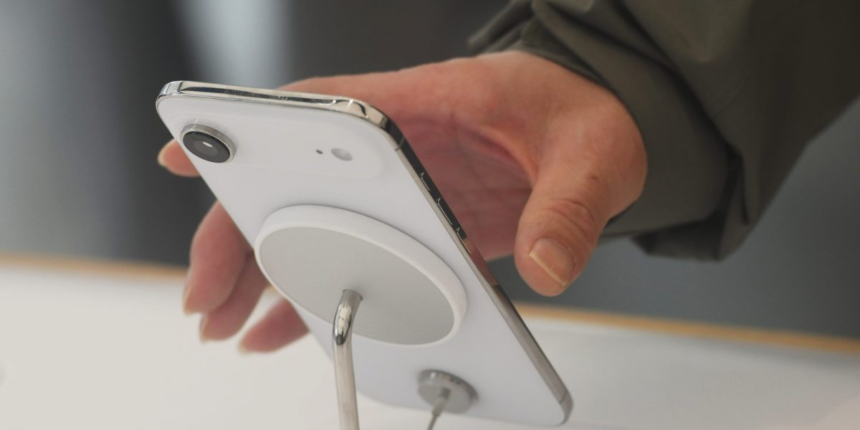
Current prototypes of the new model, code-named V62, add a second rear camera for ultrawide-angle photography, said the people, who asked not to be identified because the product hasn’t been announced. It’s now in advanced testing within Apple, they said.
Though the device retains its current look, Apple also is working to improve the battery life, according to the people. It’s unclear if that will come from a larger battery, which may be impractical in the Air’s compact chassis, or efficiency gains.
The Air, first released in September 2025, is part of a push to expand Apple’s $210 billion iPhone business with new designs. The company plans to introduce its first foldable smartphone later this year and is developing a 20th anniversary iPhone for 2027 featuring a curved screen that wraps around the device’s edges, Bloomberg News has reported.
Releasing the Air in the spring would mean that roughly a year and a half passes between the first and second generations. Still, the product’s timeline and specifications could ultimately change. A spokesperson for Cupertino, California-based Apple declined to comment.
Apple then plans to introduce a new standard iPhone — the 18 — with the refreshed Air around six months later. Two versions of the 20th anniversary iPhone will debut that fall, alongside a second generation of the foldable, Bloomberg News reported earlier this week.
The updated Air will be powered by a version of the A20 Pro processor, the same chip coming to this fall’s iPhones.
Apple sees the camera system and battery life as two of the biggest opportunities for improving the Air. The limited abilities of the current single-lens camera have drawn the most customer complaints, according to the people.
Still, the Air serves a useful purpose in Apple’s lineup. Not all customers want the features and capabilities of a Pro model, but they may be looking for something portable with an eye-catching design. Incoming Chief Executive Officer John Ternus has said that the Air helps differentiate the company’s offerings.
Apple’s efforts to offer different iPhone sizes haven’t always gone smoothly. It previously sold mini and Plus models that weren’t big sellers. Though the Air is performing better than those predecessors, it hasn’t yet emerged as one of the highest-volume iPhones. That’s one reason the company can take a bit longer to roll out a second-generation version.