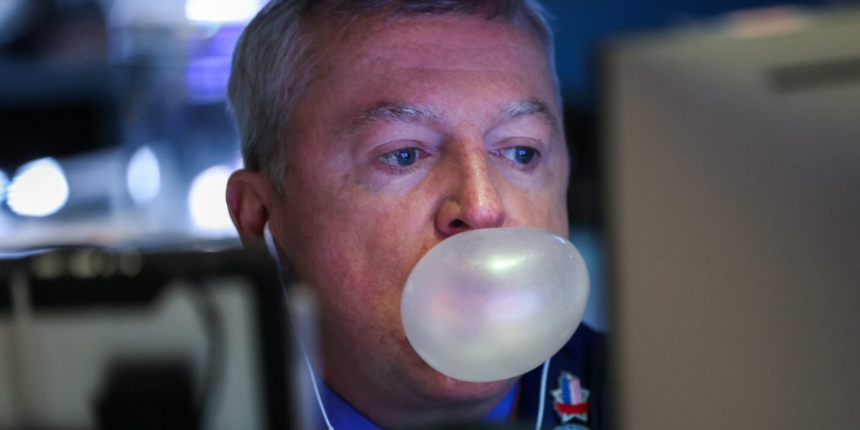
The Nasdaq’s sudden lurch lower on Friday looked like a crack in a story that had seemed, until recently, almost bulletproof—the story that artificial intelligence is not merely a useful tool but a civilizational force, the kind of technological leap that justifies paying 1999 prices for 1999-style dreams.
But a handful of analysts and investors, along with JPMorgan CEO Jamie Dimon and Bridgewater Associates founder Ray Dalio, had been warning in the days and weeks before the screens turned red that something was looking off to them.
In his framing, the danger is less that the S&P 500 is “too high” in some abstract sense, and more that investors and analysts are once again getting out over their proverbial skis.
He shared a personal anecdote that sums up the two Americas and the ever-present reality that Wall Street is not the same as Main Street. He and his wife took a road trip down the East Coast in mid-May, he said, going down to Charleston and then back through the Appalachian mountains. They stopped at a Jersey Mike’s at one point and met a man in line who had just gotten a job after five months of looking. “He was going to celebrate — by buying two big subs — one for that evening and another to put in the fridge for the next night.”
A week later, they were unable to go to one of their favorite Italian restaurants in midtown Manhattan. “We’d forgotten to book a table earlier in the week and there wasn’t a chance of getting a reservation for that evening,” he wrote, noting that OpenTable bookings were up 13% year over year in May. “It is a tale of two restaurants and just one more example of the divergent trends shaping the economic and financial environment today,” he concluded, adding that “as divergence grows across multiple dimensions, so do the risks of something going badly wrong.”
Even as Kelly and Lamont were sharpening their warnings, some of the Street’s most influential research shops were publishing forecasts that prove their point — depending on your perspective.
Four days earlier, on May 29, Goldman Sachs’ U.S. portfolio strategy team raised its forecast for 2026 U.S. IPO gross proceeds to $225 billion from $160 billion and estimated total U.S. corporate equity issuance—including follow‑ons and converts—at $675 billion, about 1% of Russell 3000 market capitalization. They also set a 12‑month price target of 8,300, implying a forward P/E near 21x, with valuation charts showing major U.S. indices trading in the upper quartile of their 20‑ and 30‑year ranges, with the Nasdaq 100 at the very top.
Dimon also flagged the role of fiscal policy, estimating that $10 trillion to $12 trillion in deficit spending over six or seven years had mechanically boosted corporate profits and demand. The risk, he suggested, is that markets are treating this as organic strength rather than a sugar high. “The government borrows money and gives it to people and that money gets spent,” he said. “It also fuels corporate profits. Corporations, it’s just not all automatically, they’re all geniuses all of a sudden.”
“At some point, you’ve got to make money,” he said. “You make investments in a business so that you can generate returns and make money. And we’ve gotten further away from that over the last couple years instead of closer to it.”
“Think about what most people actually use LLMs for,” Horne urged: summarizing articles, searching the web, rewriting emails, planning vacations and finding good food recommendations. Basically none of this needs a frontier model or tokens, he argued. “The ‘average of human knowledge’ is becoming free, and it’s becoming free fastest exactly where 95% of the demand actually lives,” he wrote. “That is a moat problem of apocalyptic proportions and almost nobody is pricing it in properly.”
In 1999, there were plenty of sharp down days before the real unwind. The question now is not whether AI is “real”—even the skeptics concede it is—but whether the cash flows and productivity gains arrive in time, and at sufficient scale, to justify the expectations that have been layered on top of it, or if AI evolves into a really great way to rewrite your emails and put your decks together, instead of a civilization-threatening apocalypse. Ironically, that outcome may lead it to threaten a market wipeout — if not apocalypse — itself. Friday’s session was a reminder that when investors are already out over their skis, it doesn’t take a recession to make the slope feel suddenly steeper.