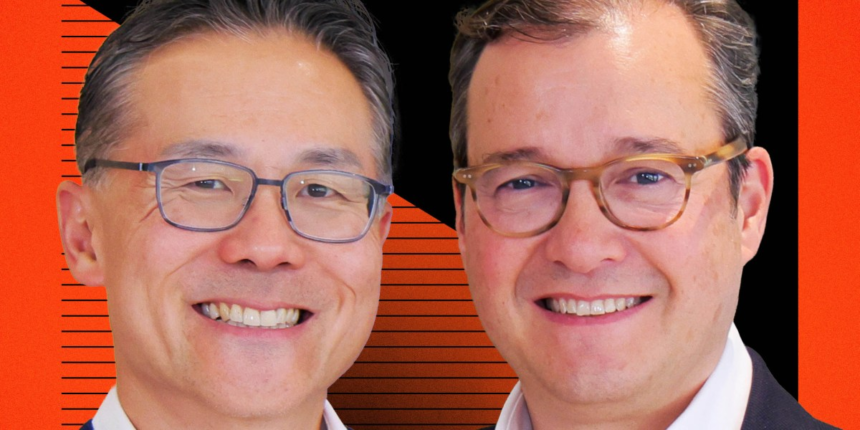
When Joe Ngai, McKinsey’s Greater China chair, first began to test-drive his point that “the next China is still China” on social media, the world’s second-largest economy was in a post-COVID slump. Sluggish consumption and a property market crash were still dragging down the country’s economy, while foreign companies were rethinking their investment in China as both a consumer market and a manufacturing hub—and asking where the “next China” might be.
“You heard all these things. We’re trying to diversify away from China. We’re trying to de-risk from China,” Ngai tells Fortune in McKinsey’s Hong Kong office. “You can’t find another China. There’s no other China out there now.”
The narrative on China’s economy is shifting. New advances in AI have reset the conversation about China’s capacity to innovate, and Chinese products are now winning converts in overseas markets. The U.S.-China relationship is no longer in free fall following U.S. President Donald Trump’s state visit to Beijing in May, the first by a U.S. leader since Trump’s last trip in 2017.
“As a board, as a CEO, you can’t just ignore China or find something else,” Ngai says. “You need a Chinese strategy.”
More recently, Chinese consumers have proved quick to switch to whatever delivers the best product at the lowest price. “In China, they always give you a shot,” Ngai says. “If you have a better thing, the market will respond.”
Ngai ultimately describes China as “the world’s toughest gym,” training hyper-competitive companies.
“This is exactly the argument Europeans used to deploy when they were looking at America,” Leung says. “They would call it cowboy capitalism. China is just an even more intense version of that extreme entrepreneurism.”
Beijing has complained about what has been termed neijuan, or “involution,” where relentless competition erodes profits for an entire industry. “The entire industry has fallen into a vicious cycle of losing money in an attempt to grab market share, ultimately dragging down the broader trend of consumption recovery,” state media outlet Economic Daily wrote in March, referring to the food delivery price war.
“The competition is at 11 right now,” Ngai says. “If you can get it to an eight, or a seven, there’ll be less wastage and less capital being destroyed.” Still, China’s capital controls mean that investors are forced to bear lower returns, because money has nowhere else to go. “It can be at ten-and-a-half for a very long time,” he admits.
“The German car companies made more money in China than they made anywhere else in the world, put together, for years,” he adds. “When you have an entitlement and you take it away? People get very upset.”
“Multinational companies felt they had a right to print money in China forever,” he adds. “And what happened? Competition happened.”
Ngai points out that Chinese entrepreneurs can make market decisions immediately while global multinationals must work through approval chains stretching back to Tokyo, Stuttgart, or New York. “When you have corporate executives fighting against local entrepreneurs who have nothing to lose,” he says, “it’s a very tough battle.”
“Those companies that manage to reimagine their China business as a business in itself—all the way from capital, ownership, management structure, and be as responsive to Chinese consumers as Chinese companies are —maintain their competitiveness,” Leung says. “Those that remain global multinationals find it hard to keep up.”
China’s “gym” might have better prepared its companies to win overseas. Chinese firms are already taking market share in Europe, Southeast Asia, and Latin America, competing on both quality and price. BYD, for example, sold more than one million cars overseas in 2025.
Some Chinese companies are starting to tentatively explore how to build a brand premium. MiHoYo, the Shanghai-based game developer behind Genshin Impact and Zenless Zone Zero, has broken into the notoriously difficult Japanese and U.S. gaming markets. More recently, Luckin Coffee has opened outlets in New York City and used viral social media campaigns and localized products to muscle into the city’s coffee scene. Li Ning, the Chinese sportswear brand, recently signed an endorsement deal with basketball star Steph Curry.
The next frontier may be AI. Chinese AI companies like DeepSeek, Moonshot AI, and MiniMax have released open-source models whose flexibility and top-tier performance are winning converts across the world, including in Silicon Valley.
“The next export from China that the U.S. hasn’t figured out how to tariff is actually tokens,” Ngai says, referring to the units of data processed by AI models. Chinese AI tokens have already overtaken U.S. tokens on some global marketplaces.
McKinsey’s history in China starts in 1993, when the U.S. consulting company put four partners in Beijing and Shanghai, years before its competitors did. It had to explain to Chinese clients what consulting actually was and its slide decks were sometimes photographed and sold outside the building for as little as 10 renminbi.
Leung, who has Swiss and Chinese heritage, joined McKinsey’s Zurich office in 1993 before transferring to Hong Kong in 1997. He served as McKinsey’s Greater China chair for more than a decade before turning to lead the McKinsey Global Institute, the firm’s economic research arm, in 2011. Ngai, who took over as Greater China chair that same year, has run the region since then.
McKinsey has had its own problems in China. In October 2024, the Wall Street Journal reported that McKinsey had cut approximately 500 jobs in Greater China, roughly a third of its regional workforce, after scaling back its client base. Partners reportedly debated whether the firm should continue to do business in China at all, given the deteriorating state of U.S.-China relations.
The firm has pulled back from serving state-owned enterprises, a sector that had become both politically fraught for a U.S. company and simply harder to serve well. “Is that growth the same as what we were thinking about in the early 2010s?” Ngai asks. “It’s probably more mature.”
“Our addressable market has become narrower,” Leung adds, “but we’re addressing a fast-growing market even within that narrow band.”
China’s economy, while improving, still hasn’t returned to the heady days of the 2000s and 2010s. Retail sales grew just 0.2% in April, the slowest rate since December 2022, the depths of the COVID pandemic. Industrial output rose 4.1%, below expectations.
“We’re in a longer-term 4% or 5% growth scenario, and we’re trending lower,” Ngai says. Yet he sees the shift as “healthy,” setting more realistic expectations about the country’s economy.
“We’re still mid-reset,” Leung adds. “It’s not a structural slowdown or structural demise. It’s not the next Japan.”
“Business conditions aren’t contingent on the two presidents meeting,” Ngai admits. “Geopolitical calm is good, but if I’m a multinational, the China market remains freaking hard. That’s not going away anytime soon.”
Still, even just setting a floor under the U.S.-China relationship is better than nothing, even if corporate and trade developments will take longer to arrive.
“A cold peace is better than no peace,” Leung says.