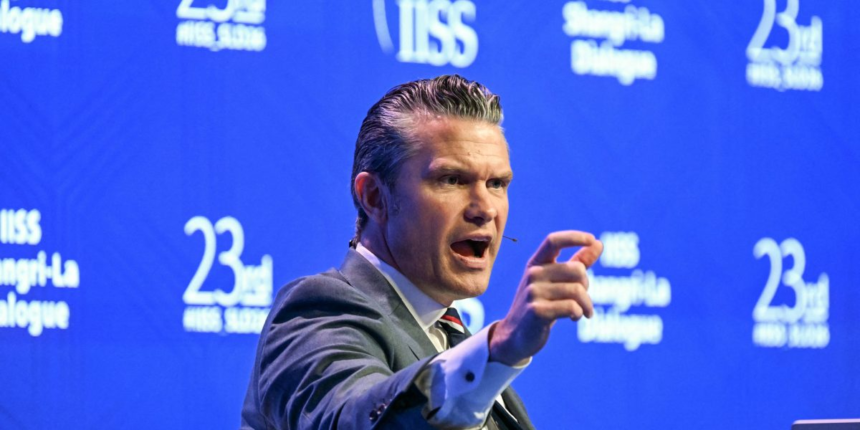
At a security forum in Singapore, Defense Secretary Pete Hegseth sought to convince US allies that staying quiet on Taiwan is the best way to project American strength. While time will tell if that’s the case, for the moment it’s a win for Chinese President Xi Jinping.
“On China, something had clearly changed: this was perhaps the least confronting speech from a US administration in the 23-year history of the Shangri-la Dialogue,” said Rory Medcalf, head of the National Security College at the Australian National University. “The great uncertainty is whether this all reflects strength or vulnerability in the US negotiating position.”
Speaking to reporters as he left Singapore on Saturday night, Hegseth said US policy toward Taiwan remained the same — with an important caveat.
“The only change you might see is how we talk,” he said, adding that the US should speak “softly, while carrying a big stick.” That phrase is widely associated with former President Theodore Roosevelt, who initiated the construction of the Panama Canal, sought to keep European powers out of Latin America and flexed American military and diplomatic muscle in both Europe and Asia.
One major test of whether US policy toward Taiwan remains unchanged in practice will be a stalled $14 billion arms package, which Trump called a “bargaining chip” following his meeting with Xi — a comment that broke decades of diplomatic norms. Hegseth wasn’t asked about Trump’s remark in public over the weekend, and sidestepped a question on whether the weapons deal would be finalized.
Taiwan Defense Minister Wellington Koo told reporters on Saturday that Hegseth’s speech overall “emphasized safeguarding peace and stability” in the Indo-Pacific. “We will continue to strengthen our self-defense capabilities, and Taiwan and the US will maintain close exchanges,” he added.
Even so, Da expressed wariness over Hegseth’s “big stick” reference to Roosevelt, saying it carried a “distinct coloring of interventionism.” While the US wants to stabilize relations, it’s also urging regional countries to increase military spending to counter China, he added.
“This is a blatant contradiction and I believe that countries in the region will make their own wise and discerning judgments,” said Da, who attended the event in Singapore.
While Hegseth sought to avoid agitating China, two US treaty allies that form the First Island Chain alongside Taiwan had some of the sharpest remarks toward Beijing.
In unusually frank comments on Sunday, Japanese Defense Minister Shinjiro Koizumi hit out at Beijing, saying it was “strange” that a country with a huge arsenal of nuclear weapons had been accusing Japan of “new militarism.”
In an interview with Bloomberg Television on Saturday, Philippine Defense Secretary Gilberto Teodoro called Japan, Vietnam and Taiwan part of a “convergence endeavor” bound by a common goal, and suggested people from Taiwan could take refuge in his nation in the event of any military invasion by China.
“Praising Taipei’s recent moves would have sent a strong and clear message about Washington’s longstanding interest in deterring conflict across the Strait,” Estep said. “Silence sends its own kind of message.”