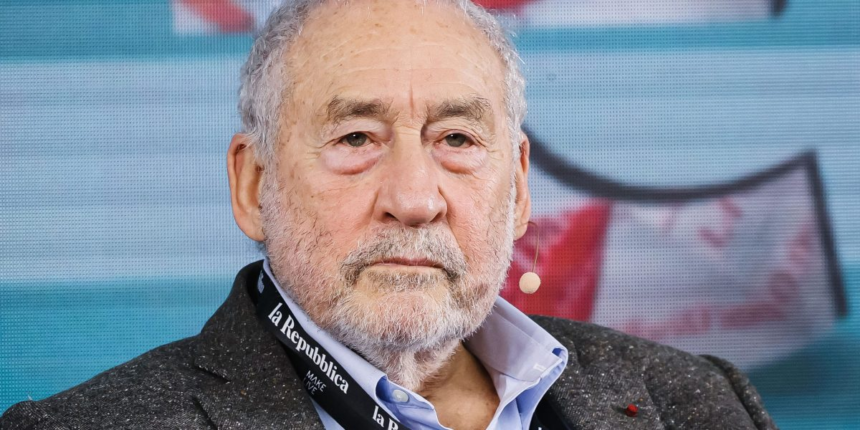
Stiglitz, a professor at Columbia University who has spent his career studying how aspects of capitalism fail. He’s studied financial crises, globalization’s broken promises, and the slow hollowing out of the American middle-class. Now, at 83, he is watching AI potentially do the same thing.
“If we don’t do anything about managing AI, there is a threat that it will lead to more inequality,” Stiglitz said. “And since inequality is such a bad, serious problem in our society, that is a great concern to me.”
AI lets firms strip labor out of production, concentrate profits at the top, and push the risks of transition onto workers and the public—exactly the trajectory the Nobel laureate warns about in his 2024 book, the recently reissued The Road to Freedom: Economics and the Good Society. The economics professor argued in an interview with Fortune, AI is emerging as a textbook case of how technology can turbocharge inequality.
The very people driving AI adoption are simultaneously leading the charge to shrink the governmental institutions that could cushion AI’s disruption. This became most evident this week, as referenced above after tech billionaires like David Sacks, Elon Musk, and Mark Zuckerberg successfully campaigned President Donald Trump not to issue an EO on AI. This poses a problem for Stiglitz, who said it’s a prime example of what happens when industries have real consequences on governance.
“Unfortunately, the tech bros, who are obviously advocates of this, are at the same time pushing for smaller government, which will undermine the ability of the government to do exactly what is needed in order to make a successful transition,” he said.
“If the tech oligarchs continue in their mindset overall of downscaling government, that will impair the ability of government to facilitate the AI transition. And you know, that’s the central boundary that we’re facing—that they are creating the conditions that make it impossible for a successful AI transition.”
The government “needs to to provide support for helping people move from where they’re no longer needed to where they might be more productive,” Stiglitz said.
“In the Great Depression, it was partly a success of agriculture. We increased productivity enormously. We didn’t need as many farmers, but we had no ability to move people out of the rural sector, and we finally did it in World War II. But it was government intervention as a result of the war that resolved that problem. We don’t have the institutional framework for doing that.”
In The Road to Freedom, Stiglitz argues when money dominates politics, policy systematically favors the already powerful, and market “freedom” becomes a cover story for entrenching inequality. Genuine freedom, Stiglitz says, is the presence of institutions strong enough to check concentrated private power and ensure that economic gains are shared broadly. A society where AI supercharges the wealth of platform owners while stripping opportunity from the middle-class is an oligarchy with better technology.
Stiglitz’s not a doomsayer—he uses AI himself to help with research. But he frames it differently, like someone pulling records rather than as a source of judgment: “I view AI as augmenting my abilities. It’s sort of like having a team of research assistants, but faster.”
Stiglitz explained it’s not AI but rather, IA. “IA is intelligence assisting,” he said. “I gave the analogy of the microscope and telescope. It sort of made our eyes see things that we couldn’t otherwise see. So they augmented our capabilities.” In his own research, AI helps him survey the literature, find sources, and stimulate new lines of thinking. “It is an amazing research tool,” he acknowledged, “but it’s not a substitute for thinking.”
The difference between IA—a tool that serves people—and AI comes down to who controls the technology, who captures the gains, and whether public institutions are strong enough to insist on a fair distribution. In a country where money shapes politics, Stiglitz is not holding his breath. “Economic inequality can be reinforced into political inequality,” he warned.