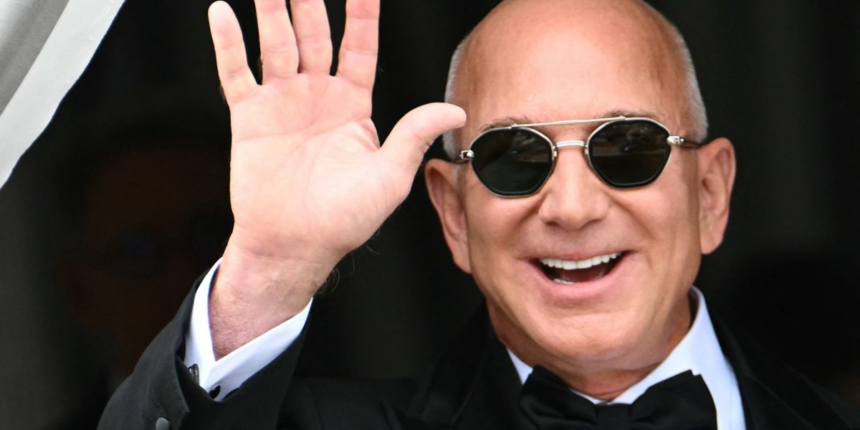
“The bottom half of income earners in this country pay only 3% of the taxes,” Bezos said. “I think it should be zero.”
To make his case, Bezos used a hypothetical health care worker as an example: “Why is a nurse in Queens who makes $75,000 a year paying more than $1,000 a month in taxes?”
Bezos added, “To me, it’s kind of absurd that we’re doing this. We shouldn’t be asking this nurse in Queens to send money to Washington. They should be sending her an apology. It really makes no sense.”
While Bezos did not elaborate on his exact calculations, workers in the U.S. are generally required to pay federal income, Social Security, Medicare—and in most states, state income—taxes. Combined, it can stretch into the thousands of dollars.
“It is part of our job as citizens and as business leaders to share our ideas,” Bezos said. “And this one would actually help people.”
Bezos’s concern for affordability may come as a surprise considering his estimated net worth north of $280 billion—the fourth highest of any person in the world. And while he said he personally pays “billions of dollars” in taxes, his tax history has long drawn scrutiny.
Still, Bezos said he is open to a policy debate over what constitutes a fair tax burden for the wealthy. The top 1% of taxpayers accounted for nearly 21% of total adjusted gross income in 2023, but paid roughly 38% of all federal income taxes that year.
“We can argue about what the fair share is. That’s a policy debate, that’s okay,” Bezos said. “But the vilification is the thing that’s just the distraction.”
“If we ran Amazon the way New York City runs their school system, your packages would take six weeks to arrive. We’d have to charge you a $100 delivery fee. And then when the package did finally arrive, it’d have the wrong item in it anyway.
“You could double the taxes I pay, and it’s not gonna help that teacher in Queens. I promise you,” he added.
Bezos argued to CNBC that the long-term societal impact of companies like Amazon and Blue Origin may ultimately prove even more valuable than philanthropy alone. Creating products and services that improve people’s lives, he said, is the kind of impact aspiring entrepreneurs should prioritize.
“Everybody out there who’s a potential entrepreneur make sure you focus on that,” Bezos said. “You will be creating value for society if you’re successful at pleasing your customers.”