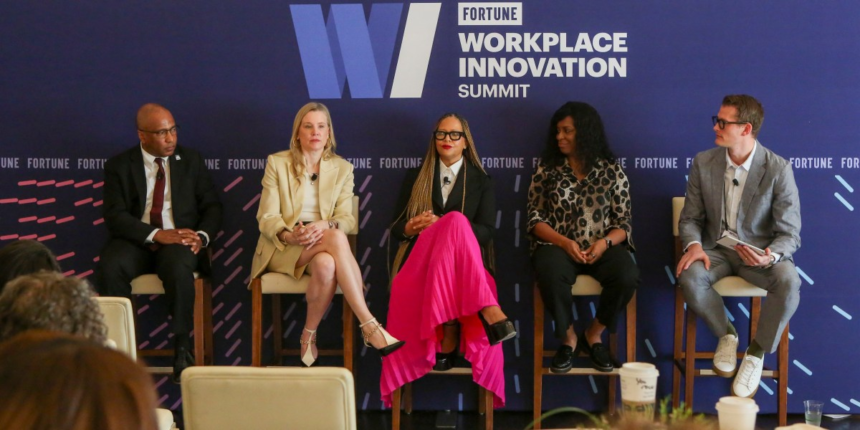
The class of 2026 is walking into one of the most unforgiving job markets in recent memory — and HR leaders are increasingly worried that the traditional on-ramps into corporate America are buckling under the weight of AI, shrinking entry-level roles, and a generation losing faith in the system.
The consensus is that the rules have changed, and nobody has fully figured out the new ones yet.
Dyson framed the structural shift starkly. “The entry-level jobs have elevated. And so the new entry-level job is now what used to be the mid-level job,” she said. “Because AI and theoretics have eliminated many of those jobs.”
That has consequences for how new workers learn the ropes. Dyson, who began her career in finance, noted that “my finance has nothing to do with what I do today. It got me through the door. But where I learned what I learned was on-the-job training. And so that’s no longer the case.”
Schmidt offered a counterweight from the employer side. “As a large employer at PepsiCo, we’re hiring pretty much still in every country that we operate in. And we have intern programs, and we have a campus.” But she acknowledged the experience has shifted: “Even Big Tech is not going to places like the University of Michigan engineering anymore; those students have to apply online, they have to represent differently.”
Mancini argued that the public discourse around AI has badly misled the people it most affects. “There’s a conversation that’s happening at the academia level, and then there’s a conversation that’s happening at the enterprise level, but there’s no conversation happening for us, and so therefore there are people just not raising their hand saying, I don’t know.”
Her advice to graduates: “Don’t base your career on social media TikTok influencers.”
Mancini was especially concerned about her own community pulling back from the technology. “A big worry for me as it relates to AI, and the black community is the lack of raising your hand to say it’s for me. There’s too much of a negative conversation going on around it, and we need to fix that.”
Dyson’s company works with large employers to hire based on demonstrated skills rather than credentials alone, and she described three dimensions employers now weigh. “You have the technical skills that you could argue that maybe you got through an education, or perhaps through trade, or what have you. Then you have these soft skills that I think are becoming much more prominent: problem-solving, critical thinking, communication, and so on. And then the third is the cultural one.”
That third dimension, she said, is increasingly the one that decides hires. “When we’ve worked with employers, and we’re asking well what has made somebody successful or unsuccessful, it’s that last dimension of the cultural fit that seems to be the knockout.”
Schmidt said PepsiCo is rethinking how it evaluates candidates beyond the résumé line items. “If you’re working in a facility and you’re going to have everything from somebody who’s doing sanitation, which actually is a certified job, all the way up to a highly skilled engineer or technician, what do you know beyond just what their job responsibilities are?”
Her example: “You may be doing this one job, but you fix cars on the weekends. That shows me you have aptitude.” She added that PepsiCo would “rather focus on retooling people who are already a culture fit than starting new. I mean, there are huge costs to that.”
Banicki raised what he was hearing anecdotally — graduates “applying to 100 jobs a week. And if they’re lucky, like a 1% success rate to even get a conversation.” Williams said his students are facing a different problem.
“I’m hearing they’re getting the interview, but they’re not closing the interview,” he said, “because they get stumped, because they can’t talk to what’s on the interview application, what they put down.”
The culprit, he suggested, is candidates leaning on AI to oversell themselves. “You look at how AI has helped you be something that you’re not when that resume comes in, because you can really do a really nice resume, but when you come into the room, you cannot talk to the technical skills that you’re talking about.”
Mancini described the same dynamic from the screening side. “Some of the platforms that use AI to source through these resumes are… can be problematic, and they can automatically just kick out. There’s no discernment.”
An audience member from the floor, an HR leader, warned that the cumulative effect is corrosive. “The issue we’re seeing is kids who are smart kids from all backgrounds getting two, 300 rejections. And I think the issue of creating a cohort of people with very low self-esteem is starting to be something that we as employers need to really start to think about.” She added, “certainly in Europe, you just look at graduate suicide and things like that. I mean, these are becoming really big issues. because people have lost hope.”
Banicki put the long-term question to the panel directly: “If you are skipping entry level, you build discernment… How do you build discernment if you don’t get to fail? How do you get better at your job?”
Williams was emphatic about what works. “Internships. These young people are even starting in their freshman year. I know some people don’t want to mess with freshmen because you say they don’t know anything, but they don’t, but they need that internship, they need that exposure.”
He described place-based training events at HBCUs, including Shelton State, St. Phillips, and Drake State, where students spent three days on campus training directly with corporate partners. “We spent three days on the campus literally training with corporations and getting them ready for… internships, apprenticeships so that when they graduate they can go straight to work.”
Schmidt described how PepsiCo has restructured its summer internships in response. “Our summer internship program is not like you’re going to go here, be here for 10 weeks, and do this task. Now we’re like, okay, you’re going to do two things because this is where I need you. They’re short-term projects. You’re going to have two supervisors, and you might be in two locations.”
Asked by an audience member to name the single skill graduates should focus on for the next five years, the panelists answered in quick succession.
“Critical thinking,” Dyson said.
“I was going to say the same thing, but being adaptive,” Schmidt added.
“Communication,” Williams said.
Mancini: “I mean, storytelling’s always queen.”
The final audience question pushed on whether AI-driven hiring tools are screening out the very people companies say they want. Schmidt acknowledged the limits of her own visibility. “We are trying to make sure that every tool we use is human-centric. It has defined accountability, it is audited, and we do check things regularly.”
She described an agent PepsiCo now uses to redirect rejected applicants toward open roles they hadn’t considered. “If you apply for a job and it’s not open, the agent will tell you all the other jobs that are available. Well, that’s not what people were doing in the past. So that’s an additive.”
Mancini urged buyers to ask harder questions of the technology itself. “If you’re investing in software, if you’re a manager, if you’re a CEO, if you’re using tools, I think it’s really important to understand who built the technology. Understanding which inputs determine which algorithms that say I should meet with you is really important when you’re talking about scale like this.”
She also worried the pendulum had swung too far away from human contact. “I don’t think that anything replaces meeting… I think we went a little too far, the pendulum swung too far, where technology was going to solve all these things, and now we have workforces that are homogenized.”
Banicki closed by asking each panelist for a reason to be hopeful.
Dyson: “We’ve got to talk about the EQ and the human intelligence. Because if we don’t invest in this balance of heart and head, that’s the optimism.”
Mancini: “We are far from not needing a human in the loop. We just opt in and understand what the technology is. And don’t believe everything that comes through your feed. The algorithm is fed on what you click on.”
Schmidt: “I think we should lean into this together. And it’s going to take many people from many different organizations to create the future. So I’m hopeful.”
Williams: “The biggest word that we use in higher ed is continuous improvement. Every single day, you’re looking at how you do things better and better and better.”
The takeaway from the room was unmistakable: the diploma still opens doors, but it no longer walks anyone through them. The work of preparing the next generation now belongs jointly to universities, employers, and students themselves — and the panelists agreed that none of them can afford to wait for someone else to start.