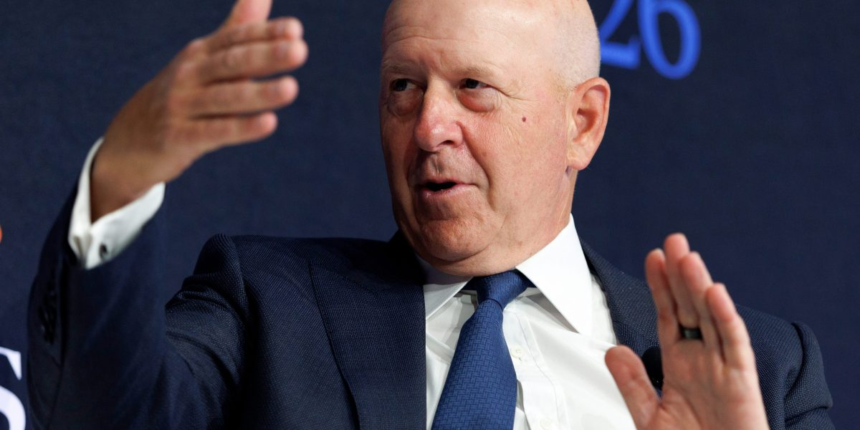
Growing up in upstate New York, Solomon kept a packed schedule: three sports, student government, and shifts scooping 31 flavors at Baskin-Robbins.
But he still didn’t have enough cash to do what he wanted. When he complained to his father, a businessman, Solomon expected sympathy—or maybe a loan.
Instead, his dad gave him a lesson in time management.
The lesson struck. Decades later, Solomon distilled it into advice for young workers navigating a labor market defined by uncertainty in the AI era: embrace criticism, stay open to change, and lean into the opportunities in front of you.
“Over my 42-year career, I found there are certain core values that transcend shifts in technology and culture,” he said. “And if you work at them, they’ll not only help you strive for excellence and capture opportunity, they will give you a better chance of looking back when you’re older like me and being satisfied with how you’ve spent your time.”
Solomon carried his hustle ethic in college, studying political science and government at Hamilton College while juggling a packed schedule of academics, rugby, and bartending on the side. As social chair of his fraternity, he also became known as the go-to mixtape creator—a passion for music that would follow him into finance.
“All sorts of people came to me saying, ‘You have to stop DJing if you want to be the CEO of Goldman Sachs,’” he recalled. “Ultimately, I decided I enjoyed DJing too much to give it up, and it’s something I still do today, although a little bit less visibly.”
As Solomon ascended to president in 2017 and CEO in 2018, he insisted the hobby wasn’t a distraction—it was a lifeline during turbulent career moments.
“It’s important to choose a profession you’re passionate about. I did. I love finance and I love the career journey I’ve been on,” Solomon said. “But it is also important and necessary I think to have passions away from your work.”
And no matter your career path, don’t let it stop you from pursuing what you enjoy—both inside and outside the office, he told graduates.
“There’s something you do, each and every one of you, that gives you excitement and joy. Don’t let it fall by the wayside. You have a long journey in front of you, full of setbacks and tough days. It will be a lot easier to pick yourself up, dust yourself off if you stay connected to what it is that lights you up.”
Fortune reached out to Goldman Sachs for further comment.
Solomon’s hard-work mindset is echoed by many who’ve reached the top of their fields.
He once arrived at the gym at 8 a.m.—what he considered an early start—only to find Bryant already on his way out.
“He was all showered up. He was done,” World Peace told Fortune earlier this year. “And I thought I was working hard!”
“I was kind of built that way,” he told Fortune last year, adding that you set “benchmarks based on your life experiences.”
“They really pushed working hard and playing hard—which, by the way, I do play hard when I’m not working—so that was the goal,” Shipchandler said.
“You know the phrase ’30 days from going out of business,’ I’ve used for 33 years,” Huang said on an episode of The Joe Rogan Experience. “But the feeling doesn’t change. The sense of vulnerability, the sense of uncertainty, the sense of insecurity—it doesn’t leave you.”