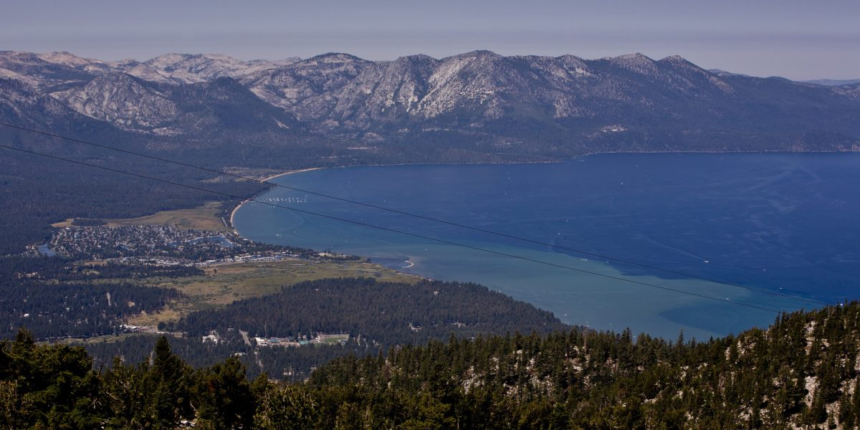
Lake Tahoe doesn’t know where its power will come from after next ski season—and it’s a major problem for the 49,000 residents who call the region home.
The Sierra Nevada tourist hub—home to ski resorts, lakeside casinos, and roughly 25 to 28 million annual visitors—is facing an energy crisis with a familiar culprit: the data centers powering the AI boom.
NV Energy, the Nevada utility that has supplied the bulk of Lake Tahoe’s electricity for decades, told Liberty Utilities—the small California company that services the region—that it will stop providing power after May 2027. The reason? NV Energy needs the capacity for data centers. As in: the energy supplier for the Lake Tahoe region is telling the utility company that it has less than a year to find another power source.
But Liberty’s 49,000 California customers may already be bearing the cost. Liberty Utilities generates about 25% of its power from solar facilities it owns in Nevada. The other 75% comes from NV Energy, and that source will no longer be supplied to the region by this time next year.
What makes Tahoe’s crisis so difficult is that no single regulator oversees the entire chain from power generation to customer bills.
The CPUC approves Liberty’s rates and procurement requests, but it cannot order NV Energy to keep selling wholesale power or dictate how Nevada plans for data centers. That falls to the Federal Energy Regulatory Commission, which regulates interstate transmission and wholesale electricity sales. With NV Energy and Nevada regulators controlling the upstream grid, the result is a system where California sets the rules, Nevada runs the wires, federal jurisdiction applies to the wholesale market, and no single entity is accountable for the outcome.
In March 2026, Liberty asked the CPUC to authorize an expedited request for proposals for replacement energy beginning June 1, 2027. In that filing, Liberty said NV Energy had cited data centers in the Tahoe-Reno Industrial Center area and northern Nevada transmission constraints, among other reasons, for ending full-requirements service.
“You need to open a full proceeding and do a transparent process and understand what we look like in California policy, and what the long-term game is,” Hughes said. Even regulators are still sorting through the legal boundaries, she added: “They’re basically trying to decide what to do right now, or even what they legally can do.”
Even the regulators are still sorting through the legal boundaries, she added: “The procurement will have to be approved by the CPUC. They’re basically trying to decide what to do right now, or even what they legally can do.”
But this is nothing new, at least according to NV Energy.
In statement to Fortune, NV Energy reiterated its spokesperson’s statement about the transition having been planned for years. “It is important to note that the NV Energy’s wholesale agreement with Liberty Utilities was always intended to be temporary and transitional, with a clear timeline and multiple extensions over the years to support Liberty’s long-term planning efforts to secure its own access to energy supply. To ensure reliable ongoing service to Lake Tahoe customers, NV Energy agreed in 2025 to continue providing energy service to Liberty’s customers until their transmission access is available and/or until Greenlink is online.”
“NV Energy has provided reliable service to Liberty’s customers in the Lake Tahoe Basin for years and fully intends to continue that commitment while Liberty secures its own transmission access and energy to supply those customers,” the utility added. “NV Energy has taken proactive steps to ensure there is no service disruption to Liberty customers, now or in the future.”
Tahoe Spark opposed the rate-case settlement, arguing that it failed to examine the interstate wholesale power structure underlying the costs paid by California ratepayers. Hughes said the problem is not merely high rates but the way costs are allocated in a region where visitor demand, second homes, ski resorts, and development projects drive infrastructure needs that permanent residents pay for.
“We’re the cost of being redistributed onto a declining community, and that is a crisis,” Hughes said.
Hughes argues that Tahoe is treated as a wealthy vacation-home market even though its year-round residents include low-income communities and essential workers. “Even though we have low-income communities in both South Lake Tahoe and North Lake Tahoe, Kings Beach, both the Energy Commission and the California Public Utility Commission do not include us in any of their socioeconomic plans,” she said.
The basin’s government structure compounds the accountability problem. Lake Tahoe spans two states, multiple counties, one incorporated city, and the Tahoe Regional Planning Agency. County supervisors, state appointees, utility regulators, and resort developers all touch parts of the system, but no single body owns the whole problem. Liberty’s demand pattern illustrates how different this territory is from the rest of California: while most regional utilities peak in summer, Liberty’s demand crests around Christmas, when second-home owners arrive for ski season — driving infrastructure costs that year-round residents bear.
Hughes said short-term replacement power is likely available from elsewhere in the West—but she’s not optimistic about what comes after. “Short term, you can commonly get good deals, but it’s unstable,” she said. “The short-term deal gets you through. But then you’re in the Western market, competing against PG&E, Southern California Edison, data centers, and mining companies. We’re 49,000 customers. We have no leverage.”
Her larger concern is that as California and Nevada move toward a more integrated Western electricity market, Tahoe’s small customer base will be increasingly exposed to competition from larger utilities and industrial buyers with far more purchasing power.
“We have no representation,” Hughes said. “It’s resource extraction.”