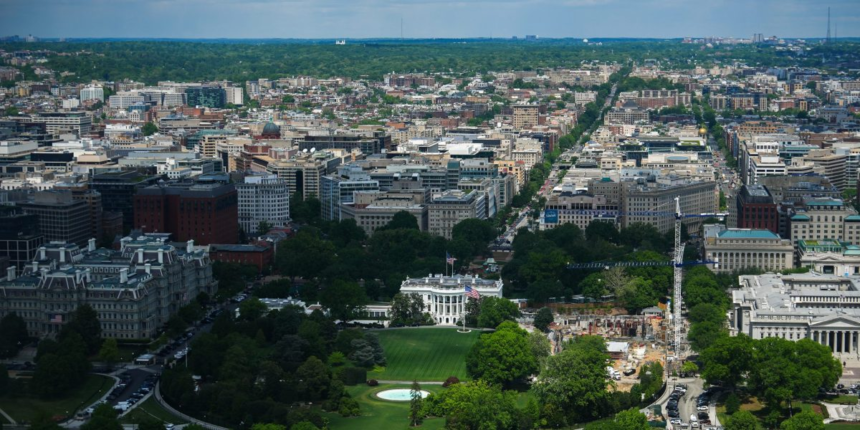
The White House ballroom, Shumate wrote, “will ensure the safety and security of the President for decades to come and prevent future assassination attempts on the President at the Washington Hilton.”
Asked about the letter, Elliot Carter, spokesperson for the National Trust for Historic Preservation, said Sunday the group would review it with legal counsel.
A crowd of 2,300 attended Saturday night’s event at the Hilton, home to one of the few rooms in Washington large enough for the event. It packs in attendees at round tables whose chairs are back to back, and room to move around is tight. The dinner is not a White House event — it is run by the White House Correspondents’ Association, a nonprofit organization of journalists from media outlets that cover the president.
For months, Trump has mentioned the ballroom project at nearly every chance, often talking about the lawsuit or his desire to construct the space during events on a number of other topics. As he addressed tuxedo- and ball gown-clad reporters who scurried from the Washington Hilton to the White House for a Saturday night news conference, Trump called for tougher security measures and pointed to the incident as a reason his ballroom is needed.
Sunday morning on X, Sen. Lindsey Graham of South Carolina said he agreed with Trump that the White House ballroom “is a national security necessity” that would give the Secret Service “immense control over the security environment of future events with a very hardened facility.”
Even some Democrats agreed. Pennsylvania Sen. John Fetterman, who attended Saturday’s dinner, said on X that the proposed White House space should be used “for events exactly like these.” On CNN later Sunday, Fetterman said attendees and Americans overall were in a “vulnerable” position during Saturday’s event, in part because many in the presidential line of succession were present and could have been harmed
Fetterman responded, “I certainly hope so” when asked if the incident would spark more support for the White House project.
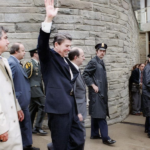
In the century-plus since its grounds were largely closed to the public, dozens of events are evidence that even the White House complex is not impervious to intrusion.
A Homeland Security Department review of the case determined that lack of training, poor staffing decisions and communication problems contributed to the embarrassing failure that ultimately led to the resignation of the head of the Secret Service.
In 1994, a pilot died when he crashed a small stolen plane on the South Lawn, hitting a tree and a first-floor corner of the building. And in 2009, uninvited guests Tareq and Michaele Salahi crashed a state dinner, passing through security checkpoints and meeting President Barack Obama in an incident that sparked security investigations.
In litigation since December, work is ongoing, although there have been recent hiccups.
On Fox News Channel on Sunday, Trump forecast that, by the end of his current term, his project would be complete.
“In the year ’28 you’re going to have something, you’re going to have a ballroom, the top of the line, security,” Trump said. “You’re not going to have problems.”