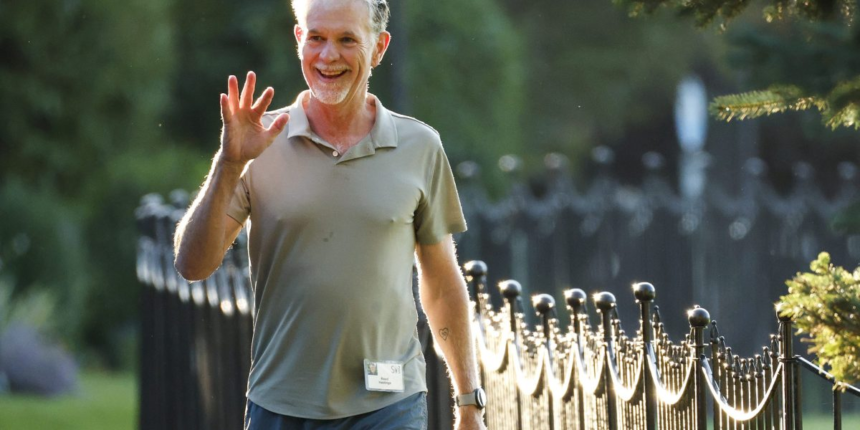
“A special thanks to Greg and Ted, whose commitment to Netflix’s greatness is so strong that I can now focus on new things,” said Hastings.
While Netflix has shown its business can thrive without Hastings in an operating role, the founder’s complete separation from the company is something of an anomaly in the tech world where founders typically remain on the board of directors for years. Nor did the timing of Hastings’s exit—coming shortly after Netflix’s failed attempt to acquire Warner Bros.—go unnoticed.
So is Hastings’s departure related to Netflix’s attempted purchase of the Hollywood movie studio, an analyst asked during Netflix’s earnings call on Thursday?
Absolutely not, said co-CEO Sarandos.
“Reed was a big champion for that deal. He championed it with the board; the board unanimously supported the deal, so … that absolutely had nothing to do with it,” Sarandos said.
Sarandos said the company is looking ahead and not backward.
“At the risk of being a broken record, I just want to remind you that we said this from the beginning, that the WB deal was a nice to have, not a need to have,” Sarandos said during Netflix’s call with analysts. “Our biggest risk was losing focus on our core business while we were working on the transaction, and as you can see from our Q1 results, we did not lose focus.”
Netflix reported net income of $5.3 billion for the first quarter of 2026, up about 82.8% from $2.9 billion a year ago. Revenue rose 16.2% to $12.25 billion. The $2.8 billion from Paramount Skydance boosted the streamer’s free cash flow to $5.1 billion, prompting Netflix to raise its full-year 2026 free cash flow forecast to $12.5 billion, up from $11 billion.
Sarandos said the company strengthened its “M&A muscle” in designing the bid and working with regulators on approvals. One of the benefits of the exercise was that executives tested their “investment discipline, and when the cost of this deal grew beyond the net value to our business and to our shareholders, we were willing to put emotion and ego aside and walk away.”
Netflix also detailed three strategic priorities in its investor letter, mapping out its playbook now that the Warner Bros. deal is off the table. The company is focusing on more entertainment, leveraging technology, and improving monetization.
Netflix is also revamping mobile viewing with a vertical video discovery feed launch planned for the end of April. Its ad-supported price tier represented 60% of all sign-ups in countries where it’s an option, and Netflix said it expects $3 billion in ad revenue this year, double its 2025 figures.
Peters reaffirmed the company’s financial goals of revenue growth of 12% to 14% and operating margin of 31.5%. He said Netflix’s audience is approaching 1 billion people, which Peters said will be “an exciting milestone to strive for” that leaves it with “plenty of room to grow.” He said Netflix’s market penetration is under 45%.