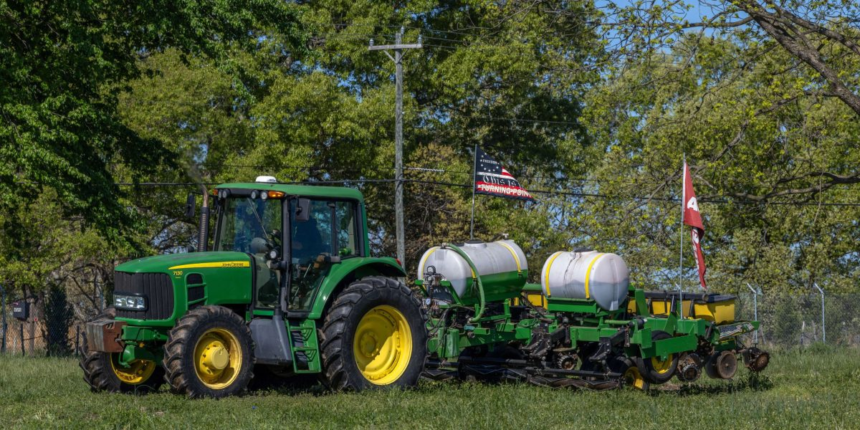
With the planting season ending in six weeks, skyrocketing fertilizer prices are forcing farmers into an impossible choice: cut back and lose crop yield or stay the course and lose money.
These rising fertilizer prices are taking a toll on farmers who for years have struggled with low commodity prices for the two major crops grown in the U.S., corn and soybeans, which have fallen 40% and 37%, respectively, from their highs in 2022. As of this week, the average price of corn was hovering at $4.15 per bushel down from a high of $6.86 a bushel in 2022. The average price of soybean was $10.30 per bushel, down from a high of about $16.40 in 2022, according to the United States Department of Agriculture (USDA).
The clock is ticking. These farmers have only until the middle of May when planting season ends to decide whether they will scale back on their fertilizer use—which in the long run could lead to lower crop yields—or absorb the elevated costs and potentially lose money on their harvest. Otherwise, some farmers may even choose to sit out the season and potentially add debt through borrowing to make ends meet, Bryan Hansel, chief revenue officer at regenerative agriculture company Holganix, told Fortune.
“This is heart-wrenching for farmers to decide, do I lose money, or do I cut fertilizer, or, like, what do I do?” he said.
To reduce farmers’ demand on fertilizer, one of the best options may be regenerative farming, said Hansel, whose company sells a product, Bio 800+, which helps build up the microbiome of topsoil.
Heavy fertilizer use has trapped farmers in a vicious cycle. Constantly using more fertilizer than crops require degrades the soil’s natural microbiome, making soil less productive over time, which requires farmers to use more fertilizer to compensate. Reducing fertilizer use would increase crop yields and cut costs for farmers, the study claimed.
But because these methods often take years to start showing effects—and because American farmers have relied on fertilizers to enable steady crop yields for so long—some are hesitant to sway from the norm, Hansel said.
Rising fertilizer prices may be changing the equation: Demand for Holganix’s Bio 800, which serves as a sort of probiotic for topsoil, has doubled compared to last year, Hansel said, partly because it can help reduce fertilizer needs in a shorter time compared to other regenerative farming methods.
Much of the reason why can be explained by the fact that for regenerative farming to work, farmers have to reduce the amount of fertilizer they use, a distressing change for some given the common belief reducing fertilizer brings lower crop yields, Hansel said.
However, if fertilizer costs continue to rise, farmers may have no better alternative.
“Nature is no longer on our side, helping us raise these crops,” Hansel said. “It’s chemistry that something has raised these crops. We need to reverse that.”