In practical terms, it was a way to pay bills without fully admitting the cost. The long-run risk wasn’t just hyperinflation; it was that once people stopped trusting the coin, everything else in the economy became harder to coordinate.
Fiscal dominance is the point at which financing needs begin to constrain the central bank’s inflation fight, and the adjustment happens through the purchasing power of money rather than through taxes or spending cuts.
Imagine the U.S. economy is a car, with the Treasury as the driver, ready to spend money at the government’s behest, and the Federal Reserve is the brake, ready to raise interest rates to slow inflation if the Treasury spends too much. The car is now towing a $38 trillion trailer. The weight is so heavy that if the Fed hits the brakes too hard, the brake pads will explode from the pressure (the government’s interest payments will become too expensive, causing a default). So, to prevent the car from crashing, the Fed is forced to let off the brake, even if the car is speeding toward the cliff of over-spending. The result: hyperinflation.
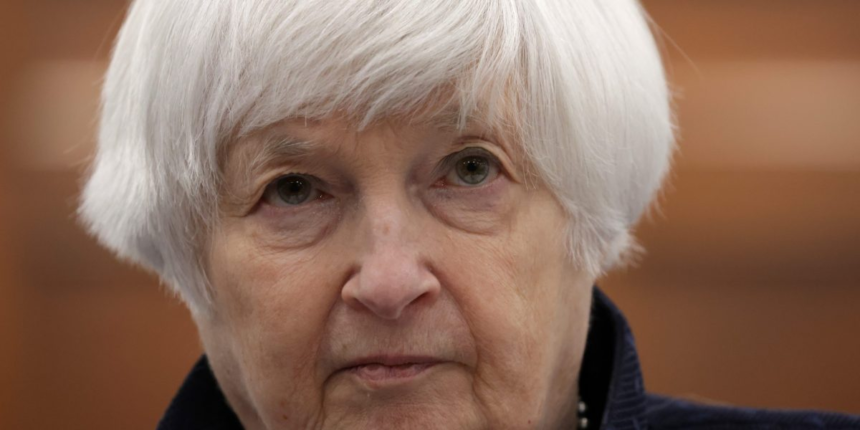
“The preconditions for fiscal dominance are clearly strengthening,” Yellen warned, noting debt is on a steep upward trajectory toward 150% of GDP over the next three decades.
While that definition centers monetary policy, other economists define fiscal dominance in different ways. Eric Leeper, a professor at the University of Virginia and former Federal Reserve economist, argues the problem is fundamentally behavioral in nature.
The death of the ‘Hamilton Norm’
For most of American history, Leeper told Fortune, the U.S. operated under the “Hamilton Norm”—the expectation that any debt issued today would be fully financed by future tax surpluses.
That norm, Leeper said, died in 2020.
When the public stops viewing government debt as an IOU for future taxes and starts viewing it as a “permanent gift,” Leeper said, the Federal Reserve loses its grip. If people don’t believe taxes will eventually rise to pay off the $38 trillion, they spend their “gift” today, driving up prices. In this world, inflation isn’t a bug, but a feature of how the Fed chooses to balance the crisis.
Leeper argued Yellen herself, during her tenure as Treasury Secretary, contributed to the current environment.
“When Yellen finally utters that phrase, that we might be seeing some signs of fiscal dominance—well, she was kind of part of it,” Leeper said. “As Treasury Secretary, she called on Congress to ‘go big’ during COVID. And at the same time, she said, ‘don’t worry, the Fed has the tools to control inflation.’ That makes clear that she doesn’t really understand what fiscal dominance is. The Fed only has the tools if we’re not in a fiscal dominant world.”
He pointed to the 2008 financial crisis as a contrast, noting that within five days of passing a stimulus package, the Obama administration announced plans to halve the deficit. He argues recent administrations have moved away from this commitment, treating debt more as a permanent increase in the money supply than a loan to be repaid.
That complicates the Economics 101 understanding of interest rates. In a traditional economy, the Fed raises interest rates to contract spending. However, with the national debt at 120% of GDP, Leeper argues the “brake” of high interest rates has turned into an “accelerator.”
Because the debt load is so massive, the interest payments the government must pay out have exploded to more than $1 trillion per year. These payments don’t vanish, but instead act as a direct injection of cash into the private sector.
But by 2026, the sheer magnitude of the debt means the impact of rate hikes is instantaneous, and thus, counterproductive.
“The bond market is the new king in the United States,” Long told Fortune. She said for most nations, crossing the 120% debt-to-GDP threshold is a “game-changer” that gives bond investors significant influence over the rest of the economy.
This influence is felt by households through higher borrowing costs for mortgages and car loans, which Long says are increasingly independent of the Fed’s actual rate decisions. If investors lose faith the U.S. will return to the “Hamilton Norm”—running surpluses to pay down debt—they may demand higher “term premiums,” effectively raising interest rates for everyone regardless of what the Fed wants, Long said.
Leeper added that while the U.S. hasn’t reached an Argentinian—or Roman—style hyperinflationary collapse yet, the situation is precarious. He argued that because Congress and the White House no longer even give “lip service” to the idea of future surpluses, the public is starting to link fiscal policy directly to inflation.
“America always does the right thing after exhausting every other option,” Leeper said, quoting the adage attributed to former UK Prime Minister Winston Churchill. “Until that faith really gets shattered, we’re okay. But if that starts to get shattered, then we’re really in deep doo-doo.”