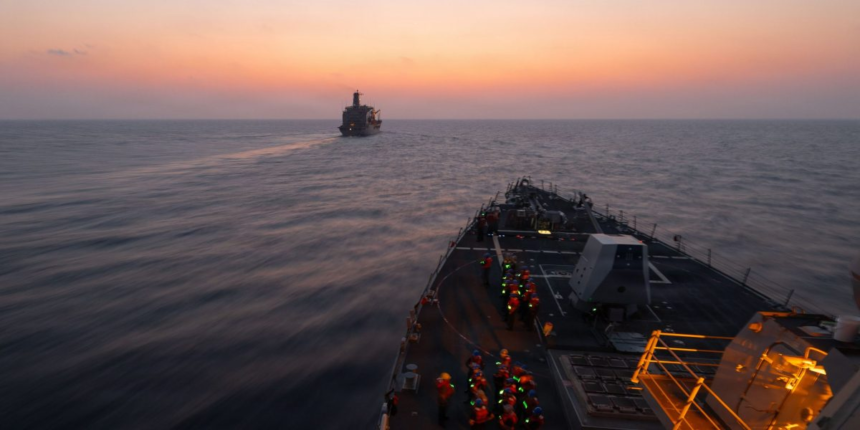
Trump on social media said the ship was warned by a U.S. Navy guided missile destroyer in the Gulf of Oman to stop, but it did not. He said the Navy “stopped them right in their tracks by blowing a hole in the engineroom” and that U.S. Marines had custody of the vessel, named Touska, and were “seeing what’s on board!”
There was no immediate Iran comment. The news threw into question Trump’s earlier announcement that U.S. negotiators would head to Pakistan on Monday for another round of talks with Iran.
Iran has not confirmed it would attend. While its chief negotiator, parliament speaker Mohammed Bagher Qalibaf, said in an interview aired on state television late Saturday that “there will be no retreat in the field of diplomacy,” he acknowledged a wide gap remained between the sides.
Host Pakistan also did not confirm a second round, but authorities began tightening security in Islamabad. A regional official involved in the efforts said mediators were finalizing preparations and U.S. advance security teams were on the ground. The official spoke on condition of anonymity because they weren’t authorized to discuss preparations with the media.
Iranian officials earlier on Sunday held firm that ships wouldn’t pass while the U.S. blockade remained in effect. “It is impossible for others to pass through the Strait of Hormuz while we cannot,” Qalibaf said.
In his post about talks, Trump accused Iran of violating the ceasefire by firing at ships transiting the strait. Iran has called the U.S. blockade a violation, and foreign ministry spokesperson Esmail Baghaei on Sunday called it an “act of aggression.”
After a brief uptick in transit attempts on Saturday, Iran fired on two Indian-flagged merchant ships that were forced to turn around, leading India to summon Iran’s ambassador over the “serious incident.” India noted that Iran earlier let several India-bound ships through.
Since most supplies to U.S. military bases in the Gulf region come through the strait, “Iran is determined to maintain oversight and control over traffic through the strait until the war fully ends,” Iran’s Supreme National Security Council said late Saturday. That means Iran-designated routes, payment of fees and issuance of transit certificates.
The council has recently acted as Iran’s de facto top decision-making body.
Pakistani Foreign Minister Ishaq Dar, who spoke by phone with Iran’s Foreign Minister Abbas Araghchi on Sunday, has said his country is working to “bridge” differences between the U.S. and Iran.
Pakistan later said Prime Minister Shehbaz Sharif spoke by phone for 45 minutes with Iran’s President Masoud Pezeshkian.
Khatibzadeh said Iran won’t hand over its stock of 970 pounds (440 kilograms) of enriched uranium to the United States, calling the idea “a nonstarter.” The deputy minister didn’t address other proposals for the enriched uranium, saying only that “we are ready to address any concerns.”