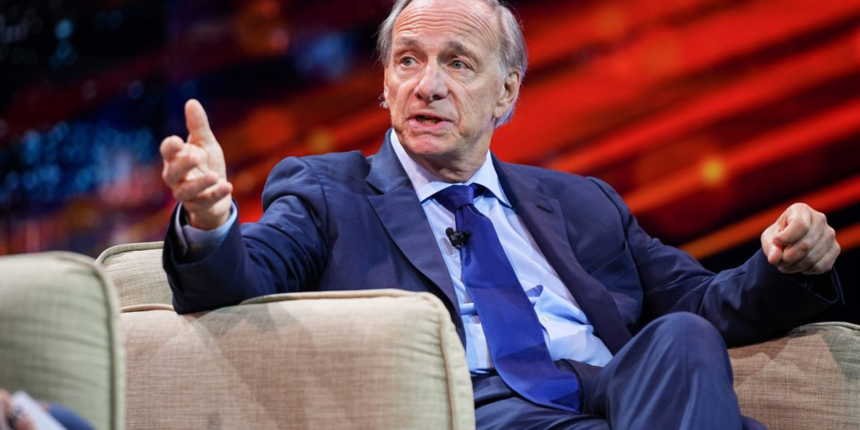
Ray Dalio built the world’s largest hedge fund on cold market logics and macro trend spotting. But when asked what really powered his rise to the top of global finance, he didn’t cite any model or macro insight at all. Instead, he credited meditation.
Dalio often describes major crises and events in terms of cycles, and he referenced meditation as the thing that lets him step outside himself long enough to see reality clearly, rather than get caught up in headlines. But in the Odd Lots interview, he also made it clear what he does with that clarity: he uses it to map out cause-and-effect relationships.
For Dalio, meditation creates the mental distance he needs to see events—markets, politics, human conflict—as linked chains rather than emotional shocks. That lens is so central to his worldview that he referenced it over and over:
“If you understand the cause-effect relationships… you can be ahead of the game. The causes happen before the effects.”
He talks about politics this way, too. Instead of seeing polarization as chaos, he thinks about the “mechanics” that produce it: incentives, cycles, interest groups, constraints. He isn’t judging them morally; he’s trying to understand how each variable begets the others.
Meditation, he says, is what lets him make that shift away from the instinct to react.
“You align the subliminal and the intellectual mind… while still feeling the emotions, but being able to look down on them and ask: How does reality work?”
Other investors into meditating
The routine Feinseth describes is simple: you sit, breathe, and repeat a mantra until your thoughts stop becoming intrusions and instead flow naturally, to the extent that you can observe them. The effect he describes is almost identical to Dalio’s.
“It does center you and relax you and calm you,” Feinseth told Fortune. “I get answers to questions… many times I’m thinking about something and, after I meditate, I’ve found a solution.”
Sometimes it’s trivial, like realizing his neighbor could fix a garage door with a side-mounted motor that he remembered seeing years ago (“We do have an incredibly accurate memory”). Other times, it’s the structure of a major research report or the right way into a thorny market call.
“Once you start to relax, things become clearer,” he said. “Sometimes the best way to think about something is not thinking about something.”
Few professions blur emotion and logic like investing, Feinseth argued.
“People act emotionally and then use logic to justify an emotional reaction,” he said. Meditation doesn’t remove that dynamic, but it can help keep you from participating in it, especially during sell-offs that are obviously out of step with fundamentals.
In practice, mindfulness means noticing a fear response during a sell-off without immediately selling, recognizing when a familiar narrative is shaping an investment thesis, or stepping back from recency-driven overconfidence. Meditation doesn’t eliminate biases, but it provides a structure for identifying and disrupting them, the authors argue.
Dalio, it appears, would agree.
“Whatever success in life I’ve had,” Dalio said, “is more because I know how to deal with what I don’t know, than anything.”