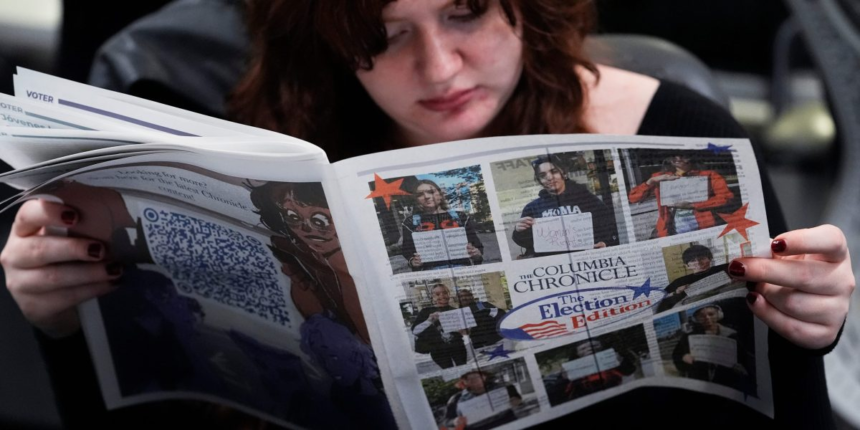
Cat Murphy, a college student, has wanted to be a journalist since she was 11. Many of her friends don’t understand why.
“There is a lot of commentary — ‘Oh, good for you. Look what you’re walking into. You’re going to be screaming into the void. You’re going to be useless,’” said Murphy, a 21-year-old graduate student at the University of Maryland’s journalism school.
More than half of the teens surveyed believe journalists regularly engage in unethical behaviors like making up details or quotes in stories, paying sources, taking visual images out of context or doing favors for advertisers. Less than a third believe reporters correct their errors, confirm facts before reporting them, gather information from multiple sources or cover stories in the public interest — practices ingrained in the DNA of reputable journalists.
“Some of this (attitude) is earned, but much of it is based on misperception,” said Peter Adams, senior vice president of research and design for the Washington-based News Literacy Project.
There are ways to turn things around, but it will take work.
Many of Lily Ogburn’s classmates get their information from social media. Their parents didn’t watch or read news reports as they grew up, so they didn’t pick up the habit, said Ogburn, a senior at Northwestern University’s journalism school.
She frequently had to explain what she did to classmates. “There’s a lot of mistrust toward journalists,” she said. But it has firmed her resolve to stick with the profession.
“I want to be a journalist that people trust,” Ogburn said, “and I want to report news that makes people believe and trust in the media.”
When the News Literacy Project asked, two-thirds of teens couldn’t think of anything when asked what movies or TV shows come to mind when they think about journalism. Those who had answers most frequently cited the “Spider-Man” franchise or the movie “Anchorman: The Legend of Ron Burgundy.” Neither portrayal was particularly flattering.
Upon retiring as editor of Newsday, Howard Schneider helped develop the State University of New York system’s first School of Journalism. But instead of teaching future writers, editors or producers, he became drawn to teaching non-journalists about being news consumers.
“The negativity, the feeling that news is biased, is just a reflection of how their parents feel,” Schneider said. “The more exposed to news, legitimate news, the more their attitudes turn positive.”
That’s one of the lessons that 16-year-old Brianne Boyack has taken from her course in news literacy at Brighton High School in Cottonwood Heights, Utah. She had little trust in news going in, but has learned the importance of double-checking sources when she sees something interesting and seeking outlets she’s found reliable.
Her classmate, Rhett MacFarlane, applied what he learned in class to investigate when a friend told him the Louvre was robbed in Paris.
“I’ve learned that there is definitely fact-checking (in journalism),” MacFarlane, also 16, told The Associated Press. “You guys are professionals and you have to tell the truth or you’d be fired. I thought you guys just did whatever you wanted and chose what to say about a topic.”
Still, news literacy programs in schools are relatively rare. Schools already have a lot of subjects to cover to prepare students for the future. And, remember, journalists don’t have the best reputations. It can be hard for educators to stick their necks out for them.
“There’s an inertia here,” Schneider said, “and this is an urgent issue.”
At the University of Maryland, Murphy said she didn’t think there was an inherent hatred toward journalists among her fellow students. “They don’t have any experience reading journalism,” she said.
That’s where she sees the journalism industry needing to make more of an effort. One of the things she finds most frustrating about her chosen field is a resistance to change, particularly an unwillingness or inability to make meaningful use of social media.
“There’s very little movement in the direction of going to where people are, as opposed to expecting them to come to where you are,” Murphy said. “The only way to turn it around is going to be to switch to doing things that captivate people today, as opposed to captivating people 20 years ago.”