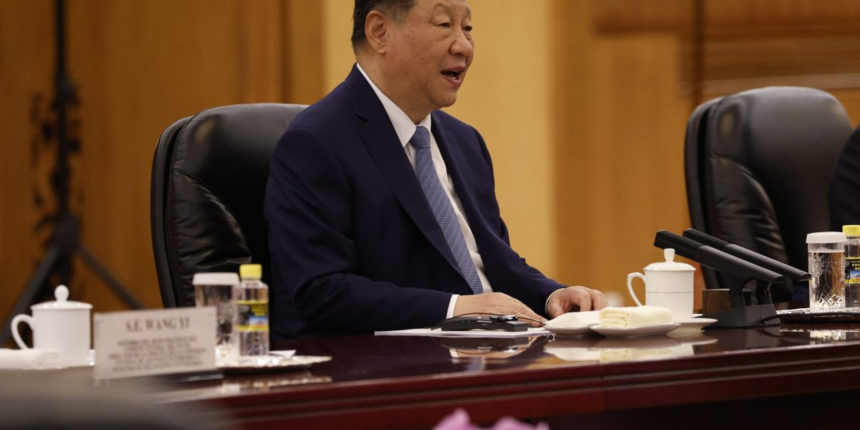
The two leaders were pledging closer bilateral ties and called for a joint front to preserve multilateralism—a pointed signal, directed at Washington, that Beijing intends to fill the vacuum left by America’s more unilateral posture on the world stage.
“I don’t think anybody knows what the outcome will be,” he said.
The stakes are enormous. Iran borders the Strait of Hormuz, a narrow waterway through which roughly 20 million barrels of oil flow daily—about 20% of global supply. Since the war began, the strait has been effectively choked: Mines have been laid, shipping traffic disrupted, and the price of passage elevated for the few vessels Tehran has permitted through. The consequences ripple far beyond energy markets. Fertilizer prices, supply chains, agricultural costs—Fink warned it all hangs in the balance.
“We’ll have global recession,” he said flatly about the worst-case scenario.
IMF Managing Director Kristalina Georgieva said ahead of the report, “Even our most optimistic scenario involves a growth downgrade,” noting without the Iran conflict, the fund had actually been preparing to upgrade its projections. Emerging markets and developing economies are expected to bear the most severe pain.
“In 2026,” he wrote, “an economics grad student might have a clear memory of only one recession, as the economy has been officially in the ‘contraction’ phase of the business cycle for only two out of the previous 200 months—February to April 2020.”