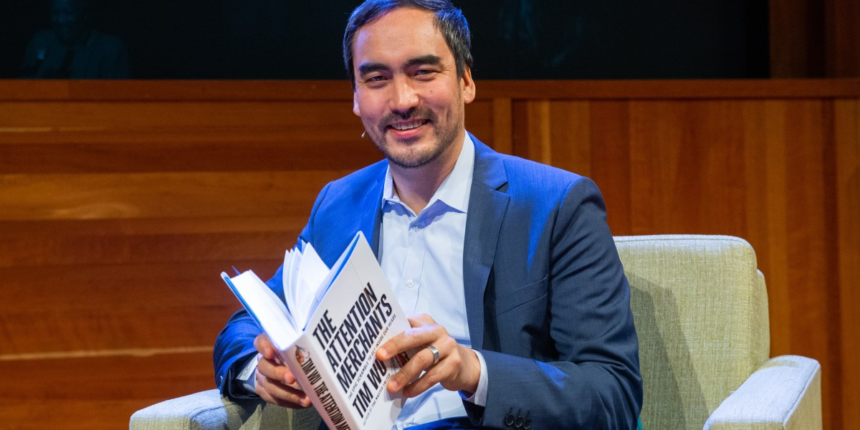
Chalking it up to a “lack of discipline,” Wu said too many companies let things drift in the modern age of extraction. Strong competitors, legal enforcement, and a company’s employees can all stress a sense of discipline, he said, “but none of those are very strong right now in so many markets …a lack of discipline lets firms get away with making their products and services worse.” Zooming out a bit further, this trend challenges the fundamental idea of American progress, especially in the tech industry, which is supposed to be the “invention industry” constantly driving improvement.
“My understanding of America is that it’s the place where things are supposed to get better,” Wu said. Living in an age when so many things are getting worse instead “cuts at the core of the idea of America, but also the tech industry [idea] of progress,” he argued—but he does see an unlikely solution.
As a sports fan, Wu said there’s a clear example of a market structure that has discipline, where things are not in fact getting worse, where things are not extracted. It’s a good product that people want to buy because it’s good: the National Football League. He said the NFL illustrates the importance of fair rules, with “aggressive rebalancing,” achieved through mechanisms such as the market cap, the draft, and adjusted schedules.
The NFL’s success serves as a model for how the U.S. economy should function. “I’m not a socialist,” Wu told Fortune. “In some ways, I’m here to try to not destroy capitalism, but return it to what it can be.” In his new book, Wu writes about the “extractors” and the “extracted” in language that sounds similar to the K-shaped economy dominating headlines in 2025, a shorthand for an economy where the rich get richer and the poor get poorer. “I think it is closely linked,” Wu said, adding it wasn’t his intention to directly link them in his book.
“I think we have moved in the direction of an economy where the focus of business models is the accumulation of market power and then extraction, which, by definition, almost by basic microeconomics is going to result in a lot of [upward] wealth redistribution.” Wu added that he thinks many of the industries that used to provide a middle class or even upper middle class lifestyle “are being driven down in favor of a couple industries that have outsized returns,” including concentrated middlemen, certain parts of finance, and tech platforms.
If Americans love the NFL so much on their TV every Sunday, he argued, why not apply the same principles from the league to how we structure our society? After all, Wu points out, he’s been right about some things before, to society’s benefit.
Wu said he wants to be humble, but genuinely believes he was right about the attention economy a decade ago. “Maybe it was sort of obvious,” he said, but the resource of human attention becoming scarcer and more valuable and “companies are very sophisticated at essentially harvesting this resource from us at a very low price.”
As a parent (his kids are 9 and 12), Wu said he notices “people are much more sensitive” about their children using attention-economy products and believes there has been a counter-movement to reclaim attention. He notes large language models are becoming popular in a very similar way and there’s no advertising on them for now, so “it’s not like the problem has gone away and it’s not as if we are able to get away from our phones. I just think it’s better recognized.”
In his conversation with Fortune, Wu reflected on his time in the Biden White House, saying it was “an important and great experience,” but he wishes they were able to do more on children’s privacy issues as he believes 99% of Americans would support legislation in this area. Yet, it was “impossible to get a vote on anything, any issue” when he worked in the White House. Congress “doesn’t want to let things get to a vote,” he said, attributing much of the gridlock to the fact that “influence of big tech over politics has just gotten so strong.”
When asked about the uproar among the New York business community about Mamdani and the term “democratic socialism,” Wu said it has become a bit of an “umbrella” term, because “a real socialist believes that all the means of production should be owned by the state” and Mamdani’s democratic socialists aren’t exactly advocating that. He said maybe some on the left would like more direct ownership of public things, but it’s more a mixture of that same “we’ve gone too far” feeling. Wu added that he personally feels most affiliated with Louis Brandeis, a judicial figure from the Progressive Movement who was influential in developing modern antitrust law and the “right to privacy” concept.
Wu said he hopes this doesn’t come to pass. There could be an America where the idea of doing business is extraction—trying to find power over someone and sucking out as much as possible—and another, better way. “I think we can do better. I’m a big believer, frankly, in business. I think we need a return to like this idea you can reap what you sow, that your investments will get you somewhere.”