The country has a long history with chips. U.S.-based National Semiconductor set up a plant there in 1968, followed by the government’s creation of Chartered Semiconductor Manufacturing in 1987. Singapore now accounts for around 10% of all chip production.
While the U.S. is trying to shore up its AI supply chain, Singapore might also benefit from being part of Pax Silica, Atreyi Kankanhalli, a computing professor from NUS, suggests. Being part of Pax Silica gives the country—which has less land area than New York City—a seat at the table when the U.S. discusses joint ventures in chip production and logistics. It also gives the resource-poor city-state a safety net to ward off future supply shocks, while enabling access to the latest AI technologies.
Both the U.S. and China are trying to leverage their dominance in particular industries against each other.
“The AI race is often framed as a battle over data or models, but the real constraints are increasingly physical—chips, energy and supply chains,” says Simon Chesterman, a law professor from NUS and the senior director of AI governance at research institute AI Singapore.
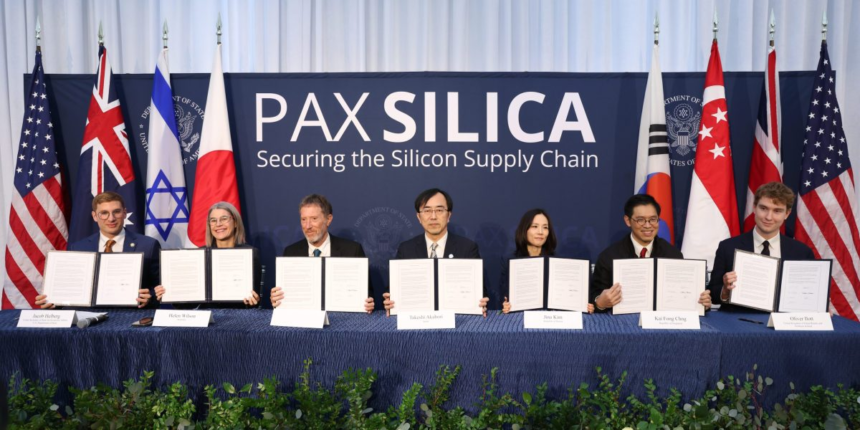
In addition to Singapore, the U.S. included several close allies in the Pax Silica agreement: Japan, South Korea, Australia, the U.K. and Israel.
Experts think that the U.S.’s inner circle on AI will soon expand. Durante, from NUS, argues that a small founding group will facilitate early coordination on sensitive issues. Several non-signatories, like the Netherlands and the United Arab Emirates, were involved in initial discussions of the Pax Silica, which Durante sees as an “outer ring” of contributors, even if they’re not yet fully aligned with the U.S
“Expansion will depend on whether Pax Silica develops concrete mechanisms, such as financing, standards, or procurement coordination,” he says, adding that countries which combine industrial relevance with willingness to align on economic-security priorities are the most likely candidates for addition.
Yet this could soon change, as Vietnam and Malaysia strive to become key hubs in the region, particularly in semiconductors and data centers.
“Pax Silica’s first wave is more focused on countries that can anchor long-term control, governance, and security across the AI stack,” says Shivraj. “Many countries play essential roles, and even if they are not part of the inner circle yet, that circle may well expand.”