“It felt like faith, God, or whatever you believe in, was looking down and saying ‘Wait a second, before going after your dream, you need to prepare yourself. You need to be ready,’” Porcini says in his office at Samsung’s R&D center near Seoul’s lively Gangnam district. “I needed to get ready for probably my dream job: Being in tech, in a world where tech is about to completely change the way we live.”
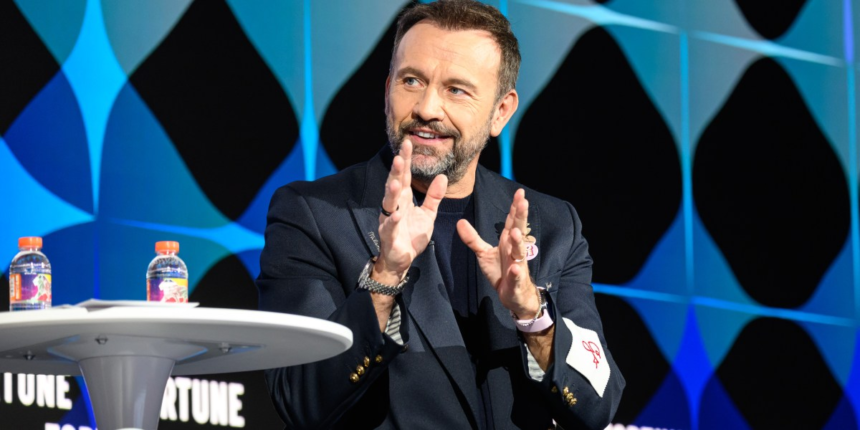
Porcini feels slightly out-of-place in the Korean chaebol’s offices. Hailing from Gallarate, a small town outside of Milan, Porcini wears plaid trousers with white racing stripes down the side, platform boots, and a beige jacket with a red lapel, quite different from the more plainly-dressed Korean designers and office workers that sit at Samsung’s desks.
Samsung has thus turned to an outsider—Porcini—and asked him use his approach to design to help the Korean company to better compete with its rivals “How can we evolve our portfolio to be as meaningful as possible to people and to the business? This is the overall mission.” Porcini asks. “How can we create the best possible products? What is their identity? How do people interact with them?”
It’s a continued bet on design from the Global 500 company, even as cost pressures and new technologies could limit the corporate appetite for expensive human designers.
In 2011, he took over design responsibilities at 3M, where he fought to make aesthetics part of the product process. “If I was making beautiful and functional products in ugly packaging, or if the experience in retail or digital was wrong, we were going to go nowhere,” he recalls. Porcini went into the field: “It wasn’t easy, because it wasn’t in my job description,” he says. “I needed to step on the toes of so many people.”
A year later, PepsiCo tapped him to be its first-ever head of design. “Industrial designers in tech, historically, focus on the product,” he says. “What I learned in consumer packaged goods was the importance of the overall experience with the brand.”
Both 3M and PepsiCo gave Porcini an appreciation for what non-designers bring to the conversation. “The ideal configuration is one where you have designers coming in with a human-centric approach, you have marketing coming in with a business perspective, and R&D coming in with a technology perspective,” he says.
Samsung is a return, of sorts, for Porcini. The designer wrote his master’s thesis on wearables, foreseeing how smart clothing and other technologies could become part of daily life even before wireless technologies like Wifi and Bluetooth were standard. And when Porcini brought PepsiCo CEO Indra Nooyi around the world to look at leaders in design, he made sure to make a stop at Samsung.
“We came all the way to Seoul in 2013 to meet the top management of Samsung and really understand how it was investing in design,” he remembers. Porcini highlights two lessons he learned from Samsung: A constant push to reinvent and revitalize its products, and “uniting the entire organization around one design mission.”
That forward-thinking approach can be attributed to late chairman Lee Kun-Hee, who pushed Samsung, one of the mega-conglomerates or chaebols that dominate South Korea’s economy, to ditch its reputation as a fast follower and compete with the best companies in consumer tech. In his 1993 “Frankfurt Declaration,” Lee urged executives to “change everything except your wife and children.”
“Lee understood design’s power in digital technology,” says Youngjin Yoo, a professor at the London School of Economics and former Samsung adviser.
Samsung designers studied how people interacted with devices; for example, consumers keep their TVs off for most of the day; they’re more like a piece of furniture than a source of entertainment. Samsung treated the television as the centerpiece to a room, a philosophy the company continues today with screens that could pass for art when not in use. (Porcini, during our conversation, points to what looks like a reproduction of Salvador Dali’s “The Persistence of Memory” behind him. “Did you know that’s a TV?” he says.)
“What Samsung did with the Bespoke line of refrigerators [a fully customizable model] and other categories was pretty brave,” Porcini says. “We need to double down on what the company is already doing, and take it to the next level.”
Yoo thinks the company lost momentum after the 2016 Galaxy Note 7 crisis, when exploding batteries forced a massive recall. “Samsung could have continued to innovate. But I think they stalled in a way,” he said.
AI also poses a threat to designers. Generative AI could be a hugely useful tool for creatives, allowing them to mock up and refine ideas much more quickly and at much lower costs. But AI could also automate their work, which could threaten jobs as companies pay closer attention to costs.
That’s partly why Porcini sees his appointment as Samsung’s chief design officer as a rare bit of good news for corporate design. “When I announced my appointment on Linkedin, and I saw hundreds of thousands of impressions … so many designers around the world saw this as hope,” he says. “I felt the pressure. Now I need to deliver, right?”
Perhaps unsurprisingly, he’s optimistic that AI will, in fact, reinforce the value that human designers can bring to companies. “Eventually, AI and robots will become a commodity,” he suggests. “Technology is a tool.”
And “in an age of extreme technology, businesses need the best humans more than ever,” he says. “Designers are the ambassadors for human beings. And creating value for humans is one of the most powerful competitive advantages you can build at a company.”