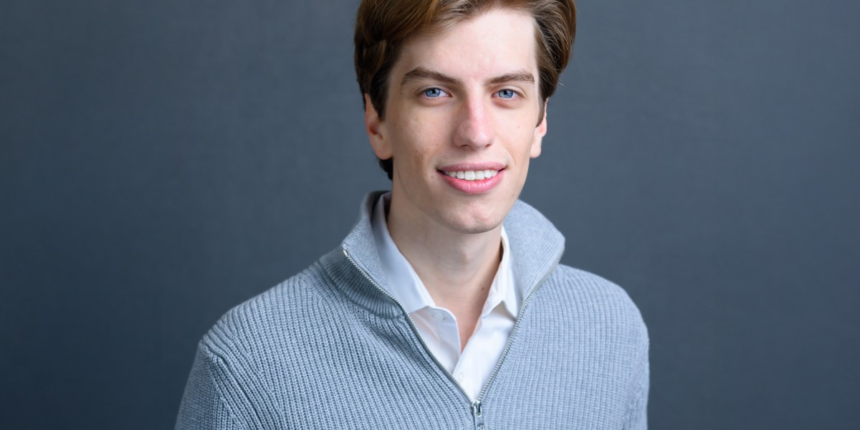
Less than two years later, Aschenbrenner is running a multibillion-dollar hedge fund based on the principles in that essay. And according to the fund’s most recent filings, released in February, those principles are currently steering him to make big bets on the kinds of massive power-generation plays that will be needed to give AGI a chance of becoming reality.
In the introduction to his essay, Aschenbrenner sketched a future he claimed was visible only to a few hundred prescient people, “most of them in San Francisco and the AI labs.” Not surprisingly, he included himself among those with “situational awareness,” while the rest of the world had “not the faintest glimmer of what is about to hit them.” To most, AI looked like hype or, at best, another internet-scale shift. What he insisted he could see more clearly was that LLMs were improving at an exponential rate, scaling rapidly toward AGI, and then beyond to “superintelligence”—with geopolitical consequences and, for those who moved early, the chance to capture the biggest economic windfall of the century. He insisted that the math itself—the scaling curves that suggested AI capabilities increased exponentially with the amount of data and computing power thrown at the same basic algorithms—showed where things were headed.
By 2025, just four years after graduating from Columbia, Aschenbrenner was controlling over $1.5 billion in investments, and had become a kind of prophet of the AI age, holding private discussions with tech CEOs, investors, and policymakers. Situational Awareness’s strategy was straightforward, betting on global stocks likely to benefit from AI—semiconductors, infrastructure, and power companies—offset by shorts on industries that could lag behind.
Now, new filings reveal where the 24-year-old Aschenbrenner is placing those bets—and just how quickly the fund has grown. Situational Awareness now reports roughly $5.5 billion in U.S. equity exposure, spread across nearly 30 holdings. According to a spokesperson, Aschenbrenner has invested almost all of his own net worth in the fund, which counts West Coast founders, family offices, institutions, and endowments among its investors.
The fund had also begun building positions in data-infrastructure and crypto-mining firms such as Core Scientific, IREN, and Applied Digital—companies that operate massive, power-hungry computing facilities originally built for bitcoin mining but increasingly being repurposed for AI workloads. Large mining operators are increasingly repositioning their high-density facilities as AI hosting hubs, reflecting a shift from valuing raw bitcoin hashrate to valuing access to electricity and data center capacity in the new AI compute economy.
The latest filings suggest the strategy is sharpening around those same themes—particularly electricity generation and companies that control large pools of computing power. Among the new or expanded positions are Bloom Energy, a fuel-cell power company that is now the fund’s single largest holding, CoreWeave, an AI cloud infrastructure provider, and Cipher Mining, another large crypto-mining firm.
As with any hedge fund, the picture is incomplete. Public 13F filings disclose only long positions in U.S.-listed stocks; short positions, derivatives, and international investments remain hidden. Still, the portfolio suggests a clear thesis: Aschenbrenner appears to be betting that the most valuable assets in the AI era may not be algorithms, but electricity and computing power. Rather than betting primarily on the companies building AI models—such as OpenAI, Anthropic, or Google—Situational Awareness is betting that the real bottlenecks in the AI boom will be electricity generation and computing capacity.
The thesis is increasingly visible on the ground: Across the U.S., the rapid expansion of AI data centers is straining power grids and creating intense competition for electricity and computing capacity. For now, investors across Silicon Valley and Wall Street are watching closely to see whether Aschenbrenner’s wager turns out to be right.