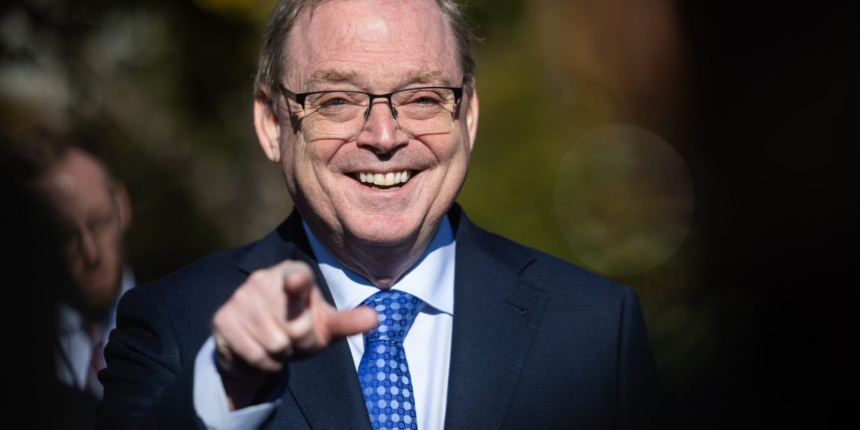
To his supporters, Hassett is a brilliant policy architect and, as longtime ally and former Trump advisor Stephen Moore puts it, a “hard money guy” who will defend the dollar. To some of his former peers, however, he has morphed into something far more concerning as an advisor to the president: a political loyalist willing to sacrifice institutional independence—and objective truth—to please his boss.
The White House did not respond to Fortune’s request for comment by press time.
To understand why the change alarms some of his onetime colleagues, it helps to recall Hassett’s extensive experience.
That’s where some of his old allies peeled off.
“If you’d asked me a year ago, I would have said I think Kevin would be a good pick,” said Dean Baker, a progressive economist who has coauthored papers with Hassett and previously supported him for the CEA. “I wouldn’t say that today. Kevin has been incredibly dishonest.”
Baker, who has spent decades dissecting BLS data, called Hassett’s talk of partisan bias “not the least bit serious,” noting that the agency’s methodology is public and constantly refined based on internal and external research. The concern, in his view, is less that Hassett genuinely believes the numbers are “cooked” and more that he’s willing to say things he knows are false because it’s what Trump wants.
“I would not count on him doing what he, in his professional opinion, thinks is correct, as opposed to what Donald Trump tells him to do,” Baker said.
He points specifically to the contrast between Hassett and Bernanke. Like Hassett, Bernanke served as the CEA chair for a Republican president (George W. Bush) before moving to the Fed.
Unlike Hassett, however, “Bernanke never compromised himself as head of the council,” Baker told Fortune. “He defended Bush’s policies, which is what you expect, but he didn’t say things that were just blatantly untrue.”
Hassett’s willingness to provide intellectual cover for Trump’s grievances extends beyond data. He has also floated a legal theory for how the president could fire Powell before his term ends.
Gregory Mankiw, a former Bush CEA chair and Harvard professor, wrote in an email to Fortune that it has been “painful” to watch Hassett on TV in these instances, when he is “vigorously defending some of President Trump’s economically illiterate policies.”
However, Mankiw added, “I like him and have considered him a good economist.” The big question, he said, is whether Hassett would show the “degree of political independence necessary to be a successful Fed chair.”
Inside Trump’s orbit, the critique that Hassett is a Trump loyalist is dismissed as establishment hand-wringing. Moore, the former Trump advisor and senior fellow at the Heritage Foundation, argued that Hassett is exactly what the doctor ordered.
“I can’t think of anybody better,” Moore told Fortune. “[Kevin] understands the purpose of the Fed is to keep inflation under control.”
William Beach, a former BLS commissioner and a Trump appointee who has known Hassett for 25 years, offered perhaps the strongest defense of all.
Beach called Hassett “a fine economist” with deep knowledge of the banking system and a rare ability to communicate clearly, skills that, he said, are essential for any Fed chair.
When pressed on Hassett’s skepticism of BLS jobs data, Beach declined to weigh in and seemed irritated, saying only that the Federal Reserve “will always rely on the best statistics available.”
In this case, though, Beach focused squarely on his long relationship with Hassett and on what he described as his “sound judgment,” saying he had “confidence [Hassett] would put the interests of the Fed and the U.S. economy first.”
While Hassett celebrated the market’s initial reaction to reports that he’s the front-runner to replace Powell, veteran Fed watchers see warning signs flashing in the bond market.
Furthermore, Hilsenrath added that while a yield near 4% might seem manageable, it is actually “exceptionally low” given that inflation remains above the Fed’s 2% target and budget deficits are near $2 trillion. If the bond market loses faith in the Fed’s independence, that disconnect could correct violently, sending rates soaring.
It reflects the “Mickey Mouse” danger Baker warned about: an administration that looks amateurish with staff too intimidated to correct the president and a Fed perceived as compliant, risking a revolt from the bond vigilantes.
“You have people who might understand the way the economy works, but they’re scared of Trump,” Baker said. “And at the end of the day, he’s the one who calls the shots.”