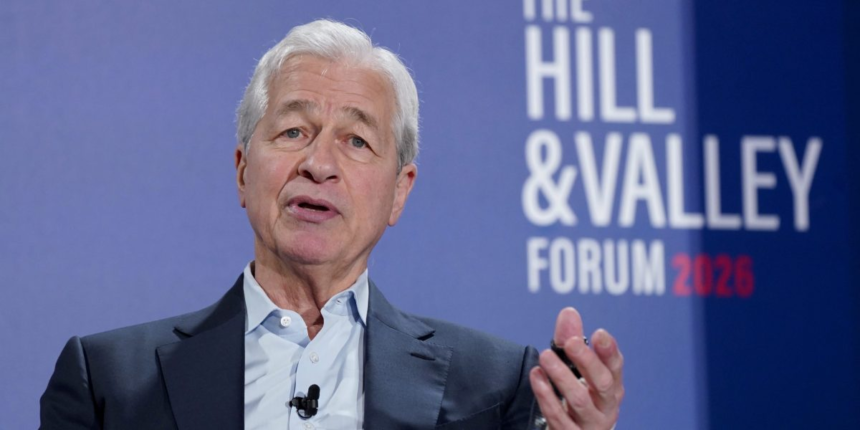
JPMorgan CEO Jamie Dimon is warning the U.S. is moving more like Europe when it comes to defense.
One example is the web of rules, compliance procedures, and the involvement of Congress that he said slows the procurement process for the Department of War (DoW) and prevents it from being adaptable in times of conflict that require quick pivots.
“We’ve become like Europe, we’re unable to move and change—change budgeting, change procurement. You know, let people do what they need to do.”
Relations between the U.S. and China have been icy in recent years, as the two countries seek to dominate AI. The world’s second largest economy has in some years grown its GDP at nearly double the rate of the U.S. At the same time, a trade war between the two economies has seen Washington impose sweeping export controls on advanced chips in an effort to limit China’s technological advancement, while China weaponizes its rare Earth resources with its own export controls on the materials that are essential to building semiconductors, but also advanced weapons systems and electric vehicles.
Dimon noted that U.S. companies made a mistake over the past decades in moving their supply chain to China just to produce a good for “$10 less.” This poses a major threat as China’s economy continues growing at a faster rate than that of the U.S. and threatens to overtake the country. Dimon also noted the risk that China may invade Taiwan is likely—something that is particularly concerning as Taiwan supplies 90% of the world’s most advanced microchips.
Still, the U.S. should also emulate China to an extent in the sectors where it has made significant progress, including shipbuilding, car manufacturing, and battery production.
“We should look at our own shortcomings then and then be prepared if they ever become an adversary to, you know, to face off against them,” he said.
Later in the interview Tuesday, Dimon painted a picture of “permanent peace” in the Middle East partly thanks to the threat of capital flight. In the process he became one of the first CEOs of a major company to foresee a potential positive impact stemming from the Iran war.
“There’s a lot of foreign direct investment going there, but it won’t go there if things like this are taking place,” Dimon said of the Gulf countries who are particularly affected by the conflict. “They’ve realized no, they need permanent peace. They can’t have neighbors like lob ballistic missiles into their data centers.”
The JPMorgan CEO said he was optimistic about the war, saying it may lead to a lasting peace in the region in the long term because of the change in “attitude” among Gulf countries including Saudi Arabia, the United Arab Emirates, and Qatar. The Iran conflict, now in its fourth week, has made these countries realize they need peace to protect the influx of capital that has helped their economies grow and diversify over the past decade.
“They’ve been murderers of Americans and other people for 40 or 50 years. That’s not a threat. That’s actual killing,” Dimon said.
Dimon’s comments come as President Donald Trump on Sunday said the U.S. would not strike Iranian energy infrastructure and power plants for five days as U.S. envoys negotiate with their counterparts in Iran.
While it’s unclear whether these talks, which Iran has denied, will yield any peace accord, Dimon said he is hopeful the conflict will bring about better prospects for the whole of the Middle East.
“I think the Iran war makes it a better chance in the long run,” Dimon said. “It’s probably riskier in the short run, because we don’t know the outcome of it, but Saudi Arabia, the UAE, Qatar, America, Israel, all want permanent peace in the Middle East.”