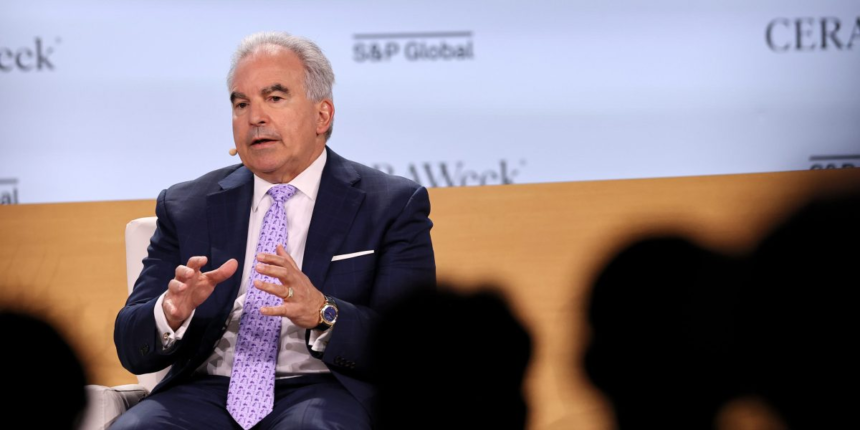
“We’re going to try to get as many molecules as we can to those countries in Asia that really need it. But it’s a 28-day journey from the Gulf Coast to anywhere in Asia, so it’s not going to happen overnight,” Fusco said at the CERAWeek by S&P Global conference in Houston.
Cheniere is planning to start bringing on production for export cargoes from its newest LNG facility—known as a “train” in industry lingo—in Corpus Christi, Texas by the end of this week, Fusco said. Natural gas must be liquefied through the LNG trains to be safely exported over water. Two more Corpus trains are slated to come online later this year. Cheniere (No. 275 on the Fortune 500) is even looking at potential maintenance delays to keep production running at full capacity for longer, he said.
“We are trying to do whatever we can. We’re looking at our maintenance schedules really hard,” Fusco said. “But, at the end of the day, we have to be safe, and we have to be reliable. We don’t want to sacrifice anything to get that last drop out.”
The last waterborne LNG shipments from Qatar to Asia that were shipped before the war began were recently delivered, so the physical supply shortages of natural gas have not yet begun, although many Asian nations have implemented conservation efforts, including mandating work from home and closing schools. “I don’t think you’ve seen a real impact just as of yet,” Fusco said.
Qatar produces about 20% of the world’s LNG that’s offline at least in the short term. But, because of damages from Iranian attacks at Qatar’s Ras Laffan facilities, Qatar said 17% of its supplies could remain offline for five years for repairs while waiting for gas turbine deliveries. And, unlike the worldwide efforts to dip into global crude oil emergency supplies, there are few strategic reserves of natural gas, which is used for power, heating, and cooking.
Meanwhile, in 10 years, the U.S. has gone from zero LNG exports to leading the world. Cheniere’s very first cargo export was in February 2016. With a wave of U.S. construction underway, the U.S. is projected to double its LNG export capacity from 2025 to 2030, growing to roughly 30 billion cubic feet per day.
Even though the growth is rapid, that help cannot come as quickly as it’s needed in the current crunch. “We saw demand really pick up in India, Pakistan, Bangladesh, Vietnam, Egypt. Unfortunately, at these high prices, those emerging markets are the ones that are going to suffer. The rich countries are going to pay whatever they have to pay,” Fusco said.
The vast majority of the LNG growth is along the U.S. Gulf Coast in Texas and Louisiana, but an Alaska LNG project is in development, and Canada became an exporter last year from British Columbia with the Shell-led LNG Canada project, offering a shorter route to Asia, with plans to grow other facilities significantly.
While there have been mounting concerns of an LNG capacity overbuild in the U.S, the domestic industry’s financial picture is now benefitting from the U.S.’ position as a secure supply for other countries.
“The current conflict has reinforced a critical lesson for LNG buyers: cost competitiveness alone is insufficient if supply security is vulnerable to single‑point‑of‑failure risks,” Morningstar analysts wrote in a March 25 report. “As a result, LNG buyers are increasingly prioritizing jurisdictional stability, contractual certainty, and diversified supply chains—criteria that strongly favor North American LNG.”
U.S. Energy Secretary Chris Wright has spent all week in Houston meeting with energy executives and repeatedly stating that natural gas is America’s “superpower.”
Despite the sharpest gas supply crisis being in Southeast Asia, most of Cheniere’s exports are still going to Europe on long-term contracts. The same applies to fellow exporter Freeport LNG.
“Europe would be at a standstill already” without U.S. LNG,” said Freeport LNG founder and CEO Michael Smith, pointing to the Russian invasion of Ukraine in 2022 and Russia’s shutting off its gas supplies to the continent. “That continues today through this crisis, which hopefully will be over very soon.”
The only saving grace from the current war is the fact that winter is over, Smith said, and natural gas demand isn’t at a peak. The crisis would be much more dire if the war unfolded right before winter.
If the war hasn’t ended though in another month or two though, Smith warned, gas supplies will really run short, and prices will spike much more in a lot of the world. “That’s a scary thing.”
“Gas demand in the world is going to continue to grow at a very high clip. There’s no way around it,” Smith said. “We offer energy security that no other country can provide”—backed by the U.S. military.
For advocates of renewable energy and the environment, the war underscores the need for the world to hasten its transition away from fossil fuels. Perhaps not surprisingly, the industry executives at the Houston conference had a different analysis.
“International gas prices have gone up by $10. In the U.S., they went up 10 cents,” Rice told Fortune. “What is the value of our energy independence? You’re seeing it right now. We’ve insulated American from supply shocks around the world on the natural gas side.”
And, more U.S. exports mean more U.S. gas demand and production, Rice said. “We should care about providing energy security to the world, because that is providing even more energy security to Americans.”