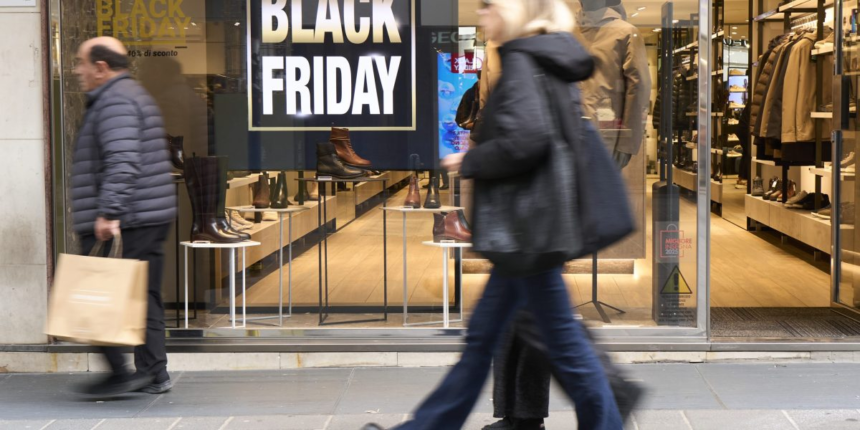
US consumers showed signs of fatigue leading up to the longest government shutdown, and their outlook has worsened ever since, sending a note of caution heading into the holiday-shopping season.
“It’s a picture of consumption — which has been a real engine of growth over the last few years — slowing quite a lot into the end of this year,” said Oliver Allen, senior US economist at Pantheon Macroeconomics.
At Best Buy, demand during back-to-school shopping and an October sale was better than analysts forecast. That performance has led executives to predict that Black Friday will be stronger than in past years, Chief Executive Officer Corie Barry told journalists on a call. She said the electronics retailer is expecting a “very strong Cyber Monday.”
“We’re seeing more caution on the consumer front, just given everything that we’re facing these days in terms of still sticky prices,” said Jennifer Lee, senior economist at BMO Capital Markets. “But we can never, ever underestimate the American consumer.”
In addition, the Conference Board’s November sentiment measure was probably distorted somewhat by the shutdown as responses were collected through Nov. 18, a few days after the shutdown ended, said Jeffrey Roach, chief economist at LPL Financial. The gauge may post a small recovery in December, now that the federal government has reopened, Eliza Winger of Bloomberg Economics said in a note.
Policymakers remain divided over whether to lower interest rates as they debate the employment outlook with inflation still running above their goal. Thanks to the shutdown, they won’t have key government data for recent months on either before they meet.
The pre-shutdown economy — through the end of September — is coming into view. In the retail sales data, spending fell in discretionary categories like electronics, clothing and sporting goods.
The figures suggest consumers lost some momentum at the end of an otherwise solid third quarter. So-called control-group sales — which feed into the government’s calculation of goods spending for gross domestic product — fell 0.1%, declining for the first time in five months.
Aggregate consumer spending is increasingly being supported by the wealthiest households, while lower- and middle-income cohorts are strained by slower pay gains and rising costs for essentials.
The wholesale inflation data showed higher energy and food costs. That offset more modest advances in prices of other goods, suggesting companies were limiting the degree of price hikes to compensate for tariffs. Excluding food and energy, the core producer price index climbed 2.6% from a year ago — the smallest gain since July 2024.
“The latest PPI data pose no obstacle to a Fed rate cut,” excluding the food-price component, Carl Weinberg, chief economist at High Frequency Economics, said in a note. “However, they offer no incentive to cut rates again, either, and the strong increase in food prices argues against further easing.”
Consumer worries about the job market were evident in a separate report that showed private payrolls fell an average of 13,500 per week in the four-week period ending Nov. 8, according to a preliminary estimate from ADP Research and the Stanford Digital Economy Lab. The two previous weekly reports also showed declines.
The government’s September employment report last week showed solid growth in payrolls, although the gains came mostly from two sectors and the unemployment rate ticked higher.
The pockets of consumer strength highlighted by Best Buy and other retailers reflect a gap between how people say they feel in surveys and how they actually spend.
“Consumer spending has been holding up quite well despite faltering confidence. The disconnect must mean that incomes are rising briskly. But the payroll report says incomes are slowing,” High Frequency Economics’ Weinberg said. “So the data are not sending a clear message right now.”