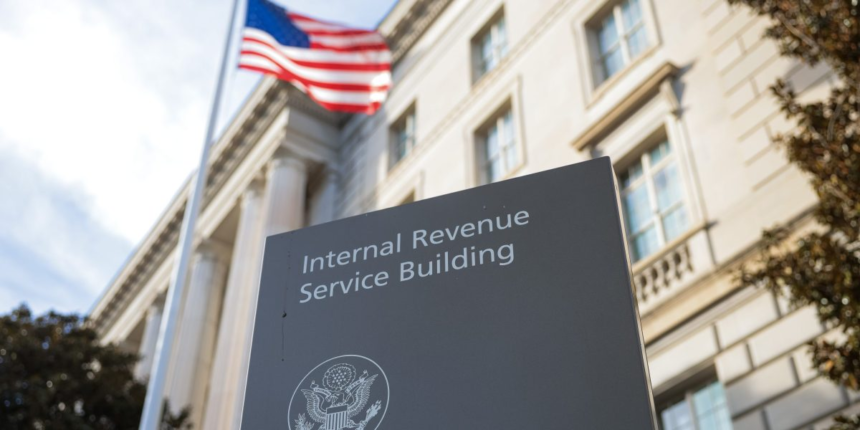
US officials have discussed creating a $1.7 billion federal fund to pay victims of so-called government weaponization to resolve President Donald Trump’s lawsuit against the Internal Revenue Service. Million-dollar payouts the administration has already made to some of his supporters provide a roadmap for where the money might go.
The settlement talks have taken place ahead of a key deadline next week in Trump’s $10 billion suit seeking to hold the IRS liable for the 2019 leak of his tax information, according to people familiar with the discussions. One of the people, who asked not to be identified as the conversations were private, said officials are considering the fund option as well as possibly dropping audits into the president, his family and his businesses. ABC News earlier reported the fund possibility.
No decisions have been made about the fund’s size. It would be open for claims regardless of a claimant’s political party, but details of how disbursements would be approved are still being negotiated.
Even if Trump doesn’t get a payout, any funding arrangement is likely to raise questions about whether the president and other US officials are improperly using taxpayer dollars to settle personal and political scores. Trump and his allies have often claimed the federal government under former President Joe Biden “weaponized” enforcement of the law, targeting conservatives for their political affiliation.
Democrats and government watchdog groups have denounced the prospect of any settlement agreement between Trump, who is represented by private counsel, and the executive branch that he controls. Indeed, the federal judge in Florida handling Trump’s IRS lawsuit is weighing whether she has jurisdiction when the president appears to control both sides of the dispute. Under the Constitution and longstanding legal precedents, courts can only hear cases in which the parties are actually at odds with each other. The judge asked for written briefs addressing the issue by May 20.
Presidents often walk back legal positions taken under prior administrations. But it’s unprecedented for a sitting president to sue his own government for compensation.
Tom Fitton, president of the conservative advocacy group Judicial Watch, said he thought Trump should receive compensation, along with the Jan. 6 defendants and Republicans “targeted” for their political affiliations.
“The federal government owes him big money for what he has suffered,” Fitton said.
The IRS data leak at the center of the case was a significant blow to the agency. A former IRS contractor, Charles Littlejohn, pleaded guilty in 2023 to stealing tax records for thousands of wealthy Americans, including Trump, Ken Griffin, Elon Musk and Jeff Bezos, and leaking them to news organizations. Littlejohn was sentenced to five years in prison.
Separate from the IRS case, Trump reportedly has two pending administrative claims against the US government. One relates to the probe into Russian interference in the 2016 election and possible connections to Trump’s campaign, while the other focuses on the criminal investigation into his handling of classified information after leaving office in 2021, according to the New York Times.
The US government’s process for resolving claims out of court is largely confidential, and Trump’s lawyers and the Justice Department haven’t publicly discussed the status of his demands. In response to questions, Trump’s legal team provided a statement that he “continues to fight back against all Democrat-led Witch Hunts.”
Spokespeople for the Justice Department and the IRS did not respond to requests for comment.
The Justice Department faced blowback from administration critics for changing its stance in court to reach $1.25 million settlements with Michael Flynn – Trump’s first national security adviser – and Carter Page, a campaign adviser.
Mark McCloskey, a lawyer for hundreds of Jan. 6 defendants who filed claims alleging violations of their rights during arrests, detentions and prosecutions, said he hadn’t received information about a potential compensation fund. He said he’d “like to see everybody get reasonable compensation” ranging from small sums to millions of dollars. More than 1,500 people were charged or convicted of crimes in connection with Jan. 6, ranging from low-level trespassing misdemeanors to assaulting police and seditious conspiracy.