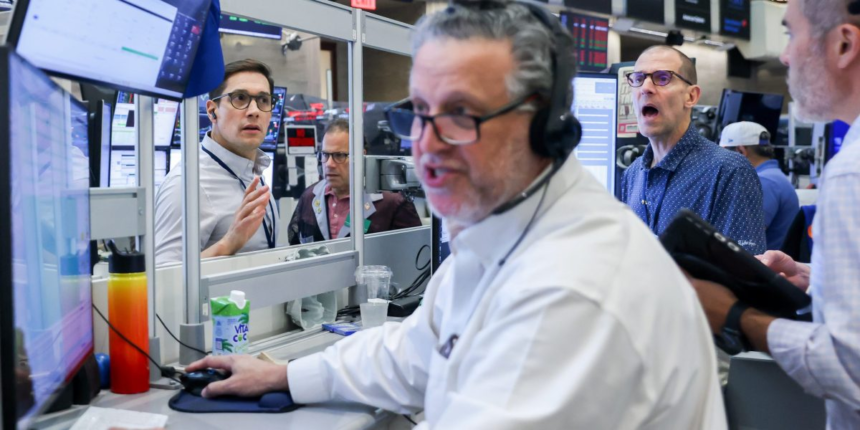
The reaction confused the White House. “With a great Jobs Report, like just announced, stocks should go up, not down,”President Donald Trump posted on Truth Social Friday morning. “That’s the way it was for 200 years. Growth does not mean inflation!”
The combination of too much demand chasing too little supply is the textbook definition for inflation—and is why consumer prices have now run above the Fed’s 2% target for more than five years. It is also why growth itself has changed meaning for markets; when supply is abundant, a strong jobs report signals more output and more profits, more room to grow. When supply is constrained, it signals more spending power pressing against that same ceiling of inflation. So if the labor market is hot, it’s evidence that the Fed has no room yet to cut rates, and might in fact have to raise them.
What he means: a stock’s price isn’t the markets estimate of future profits, it’s the market’s estimate of all the profits the company will ever earn, translated into today’s dollars. And that translation has to run through interest rates. A dollar of profit arriving in 2031 is worth less than a dollar arriving now, because money in hand can be parked in Treasuries and earn some yield in the meantime. The higher that yield, the worse that penalty is. When the 10-year pays 3%, waiting is cheap, and the future is worth not much more than face value. But when the yield is 4.5% and rising, every year of waiting costs more, and distant profits shrink fast.
Barclays’ research, Krishna said, has identified that the dynamic becomes especially acute as the yield approaches 5%. At 4.54%, “we are in the warning zone, but just in the warning zone,” Krishna said. “Five percent is more of a clear level. But as we start approaching it, the market starts pricing that risk.”
For nearly a year after last spring’s tariff selloff, retail investors decided to sit out the market recovery and came to regret it. So with this recent boom, they’ve come rushing back, trying to buy up equities while the systematic funds are also at full exposure. Barclays calls the result an asymmetric risk-reward: when nearly everyone who might buy has already bought, any good news that comes no longer drives new demand, while bad news has a market full of potential sellers.
Secondly, there’s froth. Barclays says that markets are more euphoric than ever, tracking it through an index that scans the options market across roughly 700 stocks for the signs of speculative chasing. In data going back through the dot-com era, about 7% of stocks show that pattern at any given time. The share recently climbed to roughly 10%, Krishna said, and the last time it ran meaningfully higher, reaching about 14% early this year, the March selloff followed.
Friday’s selloff, in Krishna’s view, doesn’t spell the end of the AI trade. Rather, it marks a sign of discipline in the markets. The hyperscalers, trading near 26 times forward earnings and cheaper than they were in January despite stronger profits, would be “a huge buying opportunity” if they fell further, he said. The pressure concentrates instead on companies whose valuations rest mostly on the future—”not because those business models are falling apart,” Krishna said, but “because the discount factor is going up.”
When asked whether it was surprising that a rally that withstood a war and an oil shock yet finally buckled on good news, Krishna was matter-of-fact: “It doesn’t surprise us.”