“It seems like that would be the best thing that could happen,” Trump said in an exchange with reporters when asked about pressing for the ouster of the Islamic clerical rule in Iran. “For 47 years, they’ve been talking and talking and talking.”
The president has suggested in recent weeks that his top priority is for Iran to further scale back its nuclear program, but on Friday he suggested that’s only one aspect of concessions the U.S. needs Iran to make.
Israeli Prime Minister Benjamin Netanyahu, who traveled to Washington this week for talks with Trump, has been pressing for any deal to include steps to neutralize Iran’s ballistic missile program and end its funding for proxy groups such as Hamas and Hezbollah.
“If we do it, that would be the least of the mission,” Trump said of targeting Tehran’s nuclear program, which suffered significant setbacks in U.S. military strikes last year.
Rubio, during a Senate hearing last month, noted that with Iran “you’re talking about a regime that’s in place for a very long time.”
“So that’s going to require a lot of careful thinking, if that eventuality ever presents itself,” Rubio said.
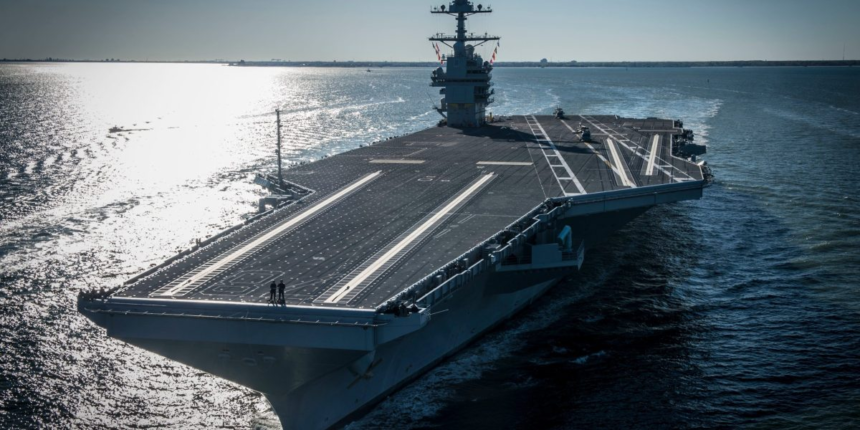
“In case we don’t make a deal, we’ll need it,” Trump told reporters about the second carrier. He added, “It’ll be leaving very soon.”
Trump in exchanges with reporters on Friday still offered measured hope that a deal can be struck with Iran.
“Give us the deal that they should have given us the first time,” Trump said about how U.S. military action can be avoided. “If they give us the right deal, we won’t do that.”
In response to questions about the movement of the Ford, U.S. Southern Command said U.S. forces in Latin America will continue to “counter illicit activities and malign actors in the Western Hemisphere.”
“While force posture evolves, our operational capability does not,” Col. Emanuel Ortiz, spokesperson for Southern Command, said in a statement. U.S. “forces remain fully ready to project power, defend themselves, and protect U.S. interests in the region.”
The Ford strike group will bring more than 5,000 additional troops to the Middle East but few capabilities or weapons that don’t already exist within the Lincoln group. Having two carriers will double the number of aircraft and munitions that are available to military planners and Trump.
Given the Ford’s current position in the Caribbean, it will likely be weeks before it is off the coast of Iran.
The USS Ford, meanwhile, first set sail in late June 2025, which means the crew will soon have been deployed for eight months. While it is unclear how long the ship will remain in the Middle East, the move sets the crew up for an unusually long deployment.
The Navy’s top officer, Adm. Daryl Caudle, told reporters last month that keeping the Ford longer at sea would be “highly disruptive” and that he was “a big non-fan of extensions.”
Carriers are typically deployed for six or seven months. “When it goes past that, that disrupts lives, it disrupts things … funerals that were planned, marriages that were planned, babies that were planned,” Caudle said.
He said extending the Ford would complicate its maintenance and upkeep by throwing off the schedule of repairs, adding more wear and tear, and increasing the equipment that will need attention.
For comparison, the aircraft carrier USS Dwight D. Eisenhower had a nine-month deployment to the Middle East in 2023 and 2024, when it spent much of its time engaged with the Iran-backed Houthi rebels in Yemen. The ship entered maintenance in early 2025 as scheduled, but it blew past its planned completion date of July and remains in the shipyard to this day.