President Donald Trump said Saturday that a deal with Iran, including opening the Strait of Hormuz, has been “largely negotiated” after calls with Israel and other allies in the region.
Announcing progress on social media, Trump said final aspects and details of the deal are being discussed and will be announced “shortly.” He was not more specific about the timetable for an announcement.
Trump said he had spoken with leaders from Saudi Arabia, the United Arab Emirates, Qatar, Pakistan, Turkey, Egypt, Jordan and Bahrain, along with Israel.
The officials and diplomat expressed hope that a final decision on the Pakistan-prepared draft could come within 48 hours as both sides review it. They spoke on condition of anonymity because they were not authorized to brief the media.
They said Vice President JD Vance and envoys Steve Witkoff and Jared Kushner played significant roles in helping bridge remaining gaps, and that Qatar played a key role by sending a senior official to Tehran to support Pakistan’s mediation efforts.
Still, both Iran and the U.S. emphasized their key positions and have warned of the risks of resuming attacks and disrupting their ceasefire. Rubio repeated the U.S. stance that Iran can never have a nuclear weapon and must turn over its highly enriched uranium, and the Strait of Hormuz must be open.
Iran state TV quoted Foreign Ministry spokesperson Esmail Baghaei as describing the draft as a “framework agreement” and adding: “We want this to include the main issues required for ending the imposed war and other issues of essential importance to us. Then, over a reasonable time span, between 30 to 60 days, details are discussed and ultimately a final agreement is reached.”
He said the Strait of Hormuz is among the topics discussed.
Positions have moved closer in recent days, Iran’s official IRNA news agency quoted Baghaei as saying.
“Over the past week, the trend has been toward narrowing differences,” he said. “We will have to wait and see what happens over the next three or four days.”
“Our focus at this stage is on ending the war on all fronts, including Lebanon,” Baghaei said, adding that lifting sanctions on Tehran “has explicitly been included in the text and remains our fixed position.”
The U.S. and Israel sparked the war with attacks on Feb. 28, cutting short nuclear talks with Iran. Tehran retaliated by effectively closing the Strait of Hormuz, a key waterway for the region’s oil, natural gas and fertilizer, causing global economic pain.
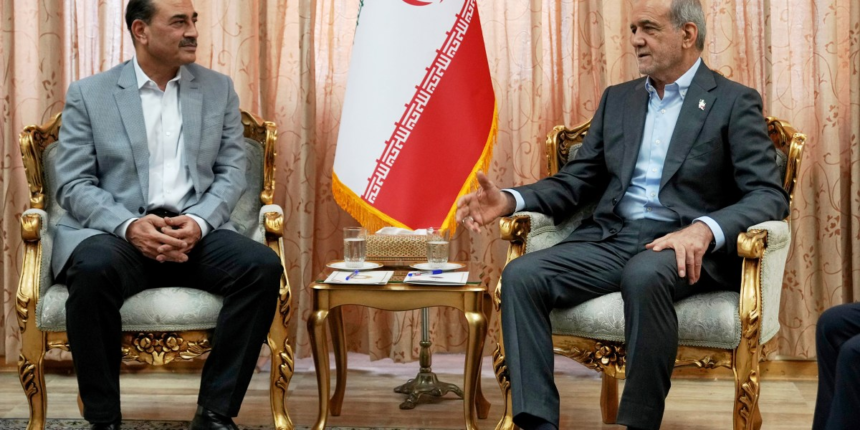
On his visit to Tehran, Pakistan’s army chief also met with Araghchi, President Masoud Pezeshkian and other senior officials, the two officials said, adding that Islamabad continues efforts to arrange a second round of direct negotiations.