U.S. District Judge Karin Immergut, who was appointed by Trump during his first term, issued the order pending further arguments in the suit. She said the relatively small protests the city has seen did not justify the use of federalized forces and allowing the deployment could harm Oregon’s state sovereignty.
“This country has a longstanding and foundational tradition of resistance to government overreach, especially in the form of military intrusion into civil affairs,” Immergut wrote. She later continued, “This historical tradition boils down to a simple proposition: this is a nation of Constitutional law, not martial law.”
The Trump administration late Saturday filed a notice of appeal to the 9th U.S. Circuit Court of Appeals.
State and city officials sued to stop the deployment last week, one day after the Trump administration announced that 200 Oregon National Guard troops would be federalized to protect federal buildings. The president called the city “war-ravaged.”
Oregon officials said that characterization was ludicrous. The U.S. Immigration and Customs Enforcement building in the city has been the site of nightly protests that typically drew a couple dozen people in recent weeks before the deployment was announced.
Generally speaking the president is allowed “a great level of deference” to federalize National Guard troops in situations where regular law enforcement forces are not able to execute the laws of the United States, the judge said, but that has not been the case in Portland.
Plaintiffs were able to show that the demonstrations at the immigration building were not significantly violent or disruptive ahead of the president’s order, the judge wrote, and “overall, the protests were small and uneventful.”
“The President’s determination was simply untethered to the facts,” Immergut wrote.
Following the ruling, White House spokesperson Abigail Jackson said that “President Trump exercised his lawful authority to protect federal assets and personnel in Portland following violent riots and attacks on law enforcement — we expect to be vindicated by a higher court.”
Oregon Attorney General Dan Rayfield called the ruling “a healthy check on the president.”
“It reaffirms what we already knew: Portland is not the president’s war-torn fantasy. Our city is not ravaged, and there is no rebellion,” Rayfield said in a statement. He added: “Members of the Oregon National Guard are not a tool for him to use in his political theater.”
Last month a federal judge ruled that the president’s deployment of some 4,700 National Guard soldiers and Marines in Los Angeles this year was illegal, but he allowed the 300 who remain in the city to stay as long as they do not enforce civilian laws. The Trump administration appealed, and an appellate panel has put the lower court’s block on hold while it moves forward.
The Portland protests have been limited to a one-block area in a city that covers about 145 square miles (375 square km) and has about 636,000 residents.
They grew somewhat following the Sept. 28 announcement of the guard deployment. The Portland Police Bureau, which has said it does not participate in immigration enforcement and only intervenes in the protests if there is vandalism or criminal activity, arrested two people on assault charges. A peaceful march earlier that day drew thousands to downtown and saw no arrests, police said.
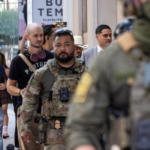
On Saturday, before the ruling was released, roughly 400 people marched to the ICE facility. The crowd included people of all ages and races, families with children and older people using walkers. Federal agents responded with chemical crowd control munitions, including tear gas canisters and less-lethal guns that sprayed pepper balls. At least six people were arrested as the protesters reached the ICE facility.
Later in the evening, federal agents again emerged from the facility and deployed tear gas on a crowd of about 100 people.