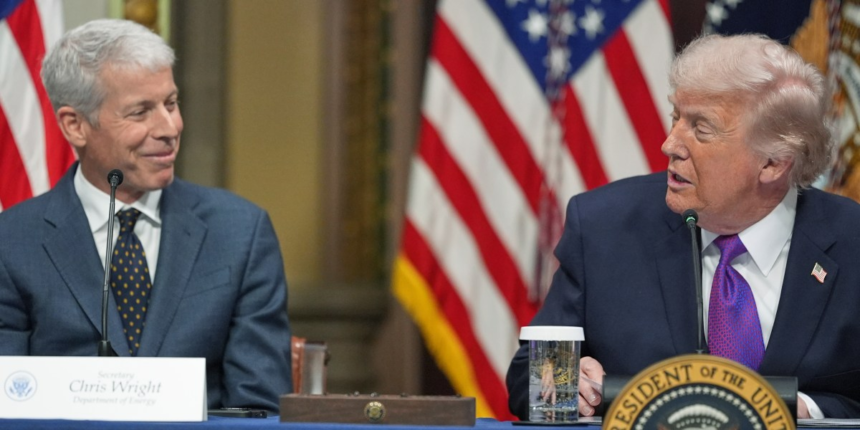
“They need some PR help because people think that if a data center goes in there, electricity prices are going to go up,” Trump said. “It’s not going to happen.”
The “ratepayer protection” pledge touted by the president comes as affordability has become a top concern for an American public wary of the possibility that the AI build out could lead to higher utility bills. Trump first announced the pledge during his State of the Union address last month, but provided few details
Trump has sought to deflect public concerns about AI, seeing the fast-evolving technology as crucial for the U.S. to attract foreign investment and maintain its economic and military prowess. But it’s unclear whether the commitments will meaningfully shield Americans from higher electricity prices that have climbed 6.3% over the past year, according to the Labor Department’s Consumer Price Index.
Under the terms of the pledge, the companies agree to build or buy new sources of power generation for their data centers and cover the expense of infrastructure upgrades. The companies could also sell excess power generation to utilities for public consumption, in addition to negotiating separate rate structures with public utilities and states, ensuring expenses are not passed on to consumers.
They also commit to making backup generation available to prevent blackouts in times of emergency, and to hire locally for their data center build out.
The voluntary agreement has no enforcement mechanisms and ratepayers have no way to verify whether tech companies keep their promises, said Lena Moffitt, executive director of Evergreen Action, an environmental group.
“Now that energy prices have skyrocketed due to his corporate polluter-first policies, Trump is trying to cover up his mistakes with a photo op,” she said.
But the Edison Electric Institute, a top lobbying group for the power industry, said the ratepayer pledge would help ensure data centers pay their fair share even as they use enormous amounts of electricity.
“We appreciate President Trump’s focus on ensuring that our nation can drive innovation while also protecting Americans who need affordable, reliable energy,” said Drew Maloney, the group’s president and CEO.
Still, the pledge speaks to Trump’s style of striking deals rather than crafting policies.
Jill Tauber, vice president of litigation for climate and energy at Earthjustice, said that actual laws and regulations needed to be in place rather than a signed pledge of unclear legal value.
“Data centers are increasing costs and pollution for communities across the country,” Tauber said in a statement. “More than a pledge, we urgently need strong policies and protections to ensure that data centers pay their way, disclose and mitigate their impacts, and are powered by clean energy.”