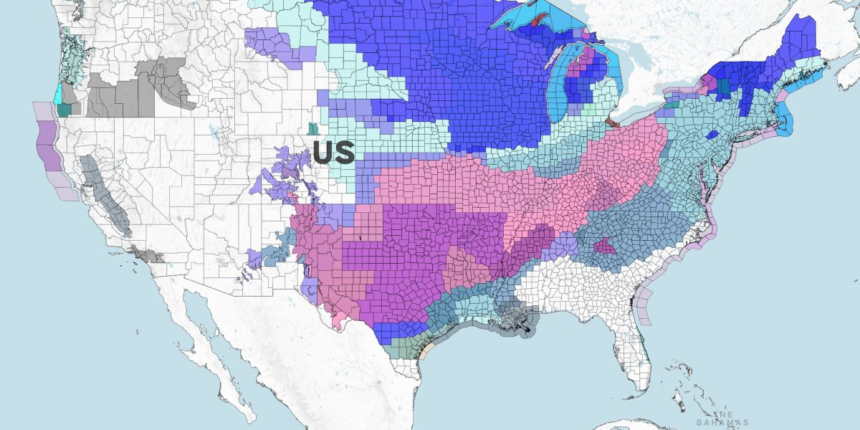
More than 170 million people — about half the population of the United States — were in the path of heavy snow and crippling ice, the National Weather Service said Friday. Alerts from the weather service stretched from Arizona and Montana in the West to the Carolinas and Maine in the east.
“Snow amounts could reach a foot or more in the I-95 major cities from D.C. to Boston,” said weather service forecasters on the East Coast, who are increasingly confident the storm will strike the big cities.
More than 1,500 flights scheduled to fly through U.S. airports Saturday were canceled by the time the storm began early Friday, according to the flight tracking website FlightAware. Airports in Dallas, Atlanta, Oklahoma and Tennessee were among the most affected.
The number of snowplows owned by the city of Jackson, Mississippi, where a mix of ice and sleet is possible this weekend. The city uses other heavy machinery like skid steers and small excavators to clear roads, said James Caldwell, deputy director of public works. Jackson also has three trucks that carry salt and sand to spread across roads before freezing weather.
The amount of ice — half an inch, or 1.27 centimeters — that can lead to a crippling ice storm, toppling trees and power lines to create widespread and long-lasting power outages. The latest forecasts from the weather service warn of the potential for a half-inch of ice or more for many areas, including parts of Arkansas, Louisiana, Alabama and Tennessee.
The number of beet juice-dispensing trucks in the city of Chicago, according to Cole Stallard, Chicago’s commissioner of Streets and Sanitation. The natural sugars of beet juice lower the freezing point of water, allowing salt mixtures to work at much lower temperatures and preventing refreezing, while also helping salt stick to the road longer.
The number of snow and ice removal trucks operated by Memphis, Tennessee’s Division of Public Works. The city also has six trucks that spread brine, a mixture designed to melt wintry precipitation. Statewide, the Tennessee Department of Transportation has 851 salt trucks and 634 brine trucks, and most of the salt trucks double as plows.
The degree in Fahrenheit when water freezes, equivalent to 0 Celsius. This is a magic number when it comes to winter weather, said Eric Guillot, a scientist at the weather service. If the temperature is slightly above 32, it will be mostly liquid. But the colder it is below the mark, the more efficiently precipitation will freeze.
The number of snowplow trucks at the ready in Nashville, Tennessee, according to the Nashville Department of Transportation and Multimodal Infrastructure.
The windchill value — how cold it feels to a person when winds are factored in — that is expected in parts of the Northern Plains, the weather service projects. That equates to minus 45.6 Celsius and is forecast for parts of northern Minnesota and North Dakota.
“When the weather forecast says, ‘feels like negative 34,’ it’s just a matter of covering skin and being prepared for it,” said Nils Anderson, who owns Duluth Gear Exchange, an outdoor equipment store in Duluth, Minnesota.
Texas has this number of pieces of winter weather equipment, including snowplows, motor graders and brine tankers, Texas Department of Transportation spokesperson Adam Hammons said. He said the agency also works with state partners and contractors to get more equipment when needed. In the Dallas area, “right now our main focus is treating our roadways in advance of the storm,” agency spokesperson Tony Hartzel said Wednesday.
The number of cubic yards of salt on hand at the Arkansas Department of Transportation. The state has 121 salt houses around the Arkansas, plus 600 salt spreaders and 700 snowplows, said Dave Parker, an agency spokesperson.