History’s greatest master class on investing is about to shut down.
Brace yourself.
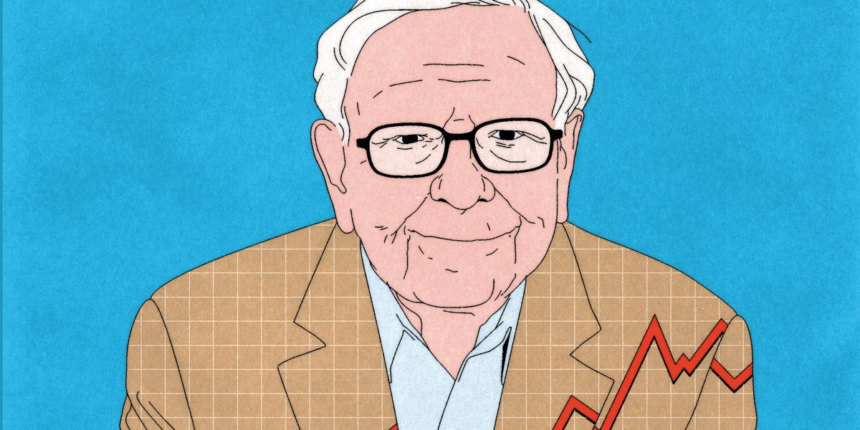
If you had put $1,000 into the S&P 500 index at the beginning of those 60 years, you’d now have $441,196—a tremendous reward for doing nothing. But if you had put your $1,000 into Berkshire stock, you would now have a truly incredible $59,681,063. Another way to think of it: If you had invested $20,000 back then, you would today be a billionaire. Without doing a thing.
That’s risky, which is the point. Successful stock pickers must summon the courage to invest large amounts of money in a few stocks. Buffett, blunt as always, has said, “Diversification is protection against ignorance. It makes little sense if you know what you are doing.” A corollary is that you shouldn’t expect to make many picks in your whole life. “I always tell the students in business school they’d be better off when they got out of business school to have a punch card with 20 punches on it,” he once told an audience at Notre Dame. “And every time they made an investment decision, they used up one of those punches.” The reality, he said, was that “they aren’t going to get 20 great ideas in their lifetime. They’re going to get five or three or seven. And you can get rich off five or three or seven.”
“You don’t need a lot of brains to be in this business. What you do need is emotional stability. You have to be able to think independently.”
Still, every industry changes eventually, sometimes in ways that drain a moat dry. For example, in 1986 Berkshire bought World Book Encyclopedia, which Buffett said had “a real moat” with its powerful brand. By 1995, with CD-ROMs and then the internet rising, he was calling it “Berkshire’s biggest problem.” Berkshire still owns the business, but it’s nothing like the profit machine Buffett had hoped for—a reminder that no one bats a thousand.
Buffett’s childhood obsession with making money, which began around age 5, produced more than charming stories. By his teens he was accumulating serious business savvy and grownup capital that enabled him to keep investing, accruing more gains, and investing more. As his biographer, Alice Schroeder, wrote in The Snowball: Warren Buffett and the Business of Life, “No one else in high school was a businessman.”
He delivered newspapers (500,000 in total, he later calculated), bought refurbished golf balls and sold them at a profit, sold sets of stamps to collectors, invested in farmland and shared the earnings with a tenant farmer. He bought a pinball machine with a friend and put it in a barbershop, then bought another machine with the money from the first one, and then bought still more. By age 16 he had $5,000, which is about $78,000 in today’s money. Unlike most of us, he knew by then that investing would be his life’s work, and he was well on his way.
And yes, Buffett envies you. In one way, and probably only one way, you have an advantage over him. To move the needle when adding to his colossal stock portfolio, he must buy gigantic volumes of a company’s shares, and pushing mountains of money toward one stock raises the price before he can buy all the shares he wants at the price he found so alluring. You, however, are almost certainly not moving markets. For an investor, he told BusinessWeek in 1999, it’s “a huge structural advantage to not have a lot of money. I think I could make you 50% a year on $1 million. No, I know I could. I guarantee that.”
Berkshire shareholders have never needed to study Buffett’s investing magic. They could just buy Berkshire stock and let him do the work, with spectacular results. But that option evaporates on Jan. 1, 2026, leaving the great question: Is Berkshire Hathaway so immersed in Buffett’s way of investing that his successors will carry it on institutionally? Or is Buffett unique in so many ways that Berkshire can never hope to continue his staggering performance?
Buffett’s 1977 letter to shareholders may suggest an answer. He described the criteria of a truly great, enduring business, as understood by him and his longtime business partner, Charlie Munger. The criterion of “enduring,” he wrote, “eliminates the business whose success depends on having a great manager…Of course, a terrific CEO is a huge asset for any enterprise…But if a business requires a superstar to produce great results, the business itself cannot be deemed great.”
Buffett is obviously a superstar, and it’s hard to see any inherent factors, other than Buffett, that have made Berkshire Hathaway so hugely successful. He seems to have chosen excellently with Abel and Berkshire’s other top executives. But the world won’t know how good they really are until they’re on their own.
Has Buffett picked a successor as superbly as he picks stocks? After 60 years, it’s the hardest call Berkshire’s shareholders have ever had to make.
This article appears in the December 2025/January 2026 issue of Fortune with the headline: “How to invest like Warren Buffett.”