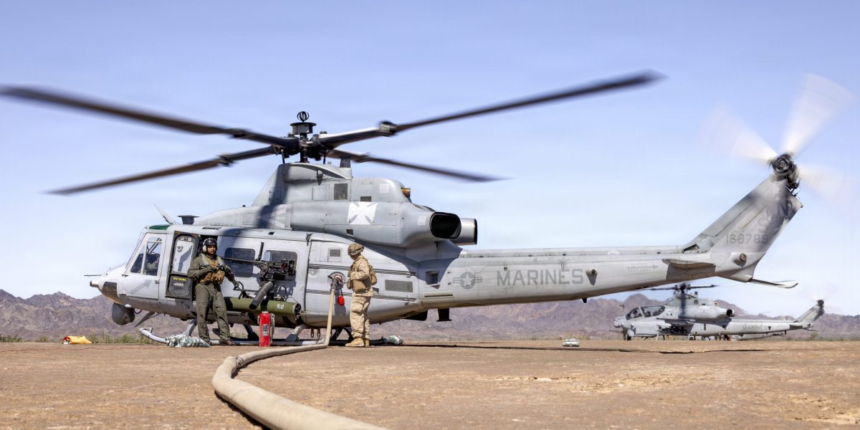
The dramatic rescue of the F-15 weapons system officer who was shot down over Iran required the U.S. military to set up an improvised airfield deep inside the country in a mountainous region near Isfahan.
The so-called forward arming and refueling point (FARP) helped enable an elaborate mission that reportedly involved hundreds of special operations troops and other military personnel as well as dozens of aircraft.
Navy SEAL Team 6 commandos eventually reached the airman, who evaded capture for more than a day and even hiked up a 7,000-foot ridge line, the report said.
But just before extraction, two C-130 transports planes designed for special ops missions got stuck at the FARP, delaying their escape, according to the Times.
While the mission was successful with no casualties reported so far beyond the F-15 airman’s injuries, it followed the first combat losses of U.S. aircraft in the Iran war.
In addition to the F-15 that was shot down, an A-10 that was providing close air support during search-and-rescue operations was also damaged by Iranian fire and crashed after the pilot flew outside Iranian airspace.
The losses came despite President Donald Trump’s claims that Iran’s air defenses no longer posed a threat to U.S. aircraft as he contemplates a potential ground assault to reopen the Strait of Hormuz.
In the event of a sustained ground mission, including a potential operation to retrieve Iran’s highly enriched uranium, setting up FARPs would likely come into play again.
They have long been part of the U.S. military’s capabilities and have been established in earlier wars. Troops also practice building them, including a Marine unit in recent days.
Separately, troops with the 31st Marine Expeditionary Unit arrived in the Middle East last weekend, and the 11th MEU is on the way, along with paratroopers with the Army’s 82nd Airborne Division.
With thousands of troops assembling in the region over the coming weeks, Trump could deploy them to seize Kharg Island, from which 90% of Iran’s oil is exported, or other small islands near the Strait of Hormuz to weaken Iran’s grip on the narrow waterway that’s critical to the global oil trade.
For now, it’s unclear if the successful rescue of the F-15 airman after a harrowing operation makes a future ground assault more or less likely.