A year or two earlier, Squeri had appeared at a board meeting, held during a New York Jets playoff game, wearing his lucky Curtis Martin jersey under a suit jacket as a “go get ’em” shout-out to his prized team. “Some directors were a bit put off,” he told Fortune. “People judged a book by its cover, and my cover wasn’t all that good.” Coworkers took notice as well. Years earlier, recalls Squeri, “one fellow manager asked me, ‘Where did you get that suit?’ and I said, ‘I’ve got five more just like it I bought for a couple hundred dollars, total.’” The colleague’s rejoinder: “Therein lies the problem.”
As the board pondered Squeri’s qualifications, the head of HR advised him, “You need to dress like a CEO,” and proposed a solution: A clothing expert from a fancy store in Connecticut would come to Squeri’s New Jersey home on a Friday afternoon to orchestrate a sartorial reengineering. “The guy drives three hours in heavy traffic, and goes through my entire closet,” says Squeri. “And I say, ‘How much of this is going to work?’ and he says, ‘None of it.’” Squeri relates that the pair then spent hours picking out fabrics for shirts, suits, sports jackets, and overcoats, and selecting elegant shoes, socks, and belts. Before the haberdasher headed home, Squeri put a king’s ransom for the new wardrobe on his Amex card.
Yet surprisingly, since Squeri took the helm in early 2018, Amex boasts the highest returns among the largest U.S. commercial banks and payment providers. In that eight-year span, its stock has generated total yearly returns of 16.6%, a record that beats all its major peers and the benchmarks (save for Goldman Sachs which barely edges it out over that timeframe).
Says Howard Grosfield, chief of U.S. consumer services at Amex: “Steve was determined to sharpen our focus on segments where we could truly differentiate and win. He doubled down not just on premium, but on attracting millennial and Gen Z customers who could deliver 20 more years of lifetime value.”
Squeri has more than proved he can crack the upper echelons—both as a CEO and diviner of what high-earners want. Now, he just has to do what’s arguably even harder: keep those millions of millennials and Gen Zers happy and charging against the backdrop of an economy where everything is highly uncertain.
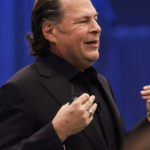
It’s 9 a.m. on a brisk day in mid-March, and the six-two Squeri appears in his top-floor Manhattan office, fresh from a workout in the building’s gym. Today he’s attired in a gray hoodie over a white T-shirt. The nod to his now elevated taste can be seen in the Brunello Cucinelli logo embossing the sweatshirt and the Zegna shoes that he describes as “triple-stitch”—“I have 12 pairs of them”—as well as his Breitling watch. “We’ve partnered by providing offers on Breitling watches,” he declares, “I’ve got a few of those.” The office itself leans toward old-school classicism, its conference and sitting rooms decorated with museum-quality Hudson River School paintings and 19th-century antiques.
Lounging on a sofa and framed by floor-to-ceiling windows overlooking lower Manhattan, Squeri relates that he rides a stationary bike for a half-hour and lifts weights around 20 minutes five days a week, and has just breakfasted on oatmeal and tea. He eschews coffee, he says, not because he doesn’t like the taste—“I’ve never had a cup”—but because he detests the aroma. Squeri doesn’t need caffeine. Pumping iron, and apparently the exhilaration of combat, has got this 67-year-old plenty pumped.
It’s a matter of pride that some of his best ideas come not from surveys or focus groups but especially from surveying what his own kids and their friends are doing. How did he glean that the youthful and affluent would flock to Platinum? “I just looked at my own household,” he says. “I have four daughters. When they talk, I listen. They make me listen. They’re very value-conscious—it’s always about a deal. When my oldest graduated from college, she got a Platinum Card. She was traveling all over the country visiting friends and going to weddings. She told me she liked the lounge access, that she liked the Uber credits; she liked the early check-in and 4 p.m. checkout at the hotels. She went for the luxury stuff, not points, and it was the same for her friends.”
Squeri relates that his grandfather Giuseppe Squeri immigrated from Parma, Italy, through Ellis Island a century ago. “He couldn’t read or speak English but went on to work as a porter then in a speakeasy during Prohibition, and finally running his own bar,” says the CEO. Squeri and his three brothers shared a two-bedroom apartment with their parents in the blue-collar Queens neighborhood of Astoria. At nearby Monsignor McClancy Memorial High School, he formed a lifelong friendship with Nick Melito, who’s been McClancy’s president for six years. “We played on the basketball team together,” Melito told Fortune. “He’d come off the bench as an outstanding rebounder. But he was big and awkward, and he was shy. I’d try to bring him out a little bit. At school dances, he didn’t want to dance, and I’d say, ‘Come on!’”
“My father always worked two full-time jobs, and one was as a floor manager at Bloomingdale’s,” recalls Squeri. While at Manhattan University, a Catholic institution in the Bronx, Squeri labored full-time at the elegant department store as “a stock guy” and in the rug department. “If you were just a stock guy, you were looked down upon by the Ivy League people in the training program,” he says. Today, Squeri avows, “My best friends are from kindergarten and high school. People are authentic in Queens.” He serves on the boards of both McClancy and Manhattan University. He stepped away from the public boards he was on when he became CEO and hasn’t joined others since.
Squeri turned all the negativity into a quest to prove the naysayers wrong. “I guess you could say I had a chip on my shoulder,” he allowed in a 2024 podcast. “It’s served me well.”
Still, Squeri partly credited moving up at all to strenuous effort to burnish his homespun persona. Long before refilling his closets, “I was told, early in my career, ‘English is your second language,’” he declares. “I grew up speaking English, but I didn’t speak the ‘goodly’ English. I didn’t use all the letters in the alphabet all the time, I spoke the way I spoke growing up.” So Squeri “voluntarily” took training in elocution. “There’s a video of me somewhere reading from The Cat in the Hat, saying the King’s English, ‘More green eggs than ham.’ I still consider myself a work in progress overall, but I can riff into my Queens speak, and I can riff into something you’d expect of a corporate executive.”
Squeri then recounts what must rank as one of the most surprising CEO succession dramas ever. The clear front-runner as Chenault’s successor was president Ed Gilligan, one of Squeri’s best friends and an executive whom he’d worked alongside in three different jobs. “I was planning on retiring at age 60 in 2018,” says Squeri. “Ken already told me he didn’t think I was going to be CEO, which was fine, because I had no aspirations to be CEO.” In May of 2015, Amex’s road map for leadership suddenly got shredded: On a corporate jet flying back from Tokyo, Gilligan suffered a fatal heart attack.
To make matters worse, the introduction of the Chase Sapphire Reserve card in mid-2016 posed a big threat to the supremacy of the Platinum Card, then sorely in need of a refresh. Chenault assigned the crisis management role to Squeri.
“Ken told me we were going to take out a billion dollars in operating expenses, and we ended up exceeding that target and putting that back into new products,” Squeri relates. His success in leading the restructuring greatly impressed his boss. “Ken asked me to take a lot more of a leadership position. And as time went on, it became clearer to Ken that, A, I could do the CEO job, and B, I was really serious about doing the CEO job.” While the pair golfed at the Hamptons’ historic Shinnecock Hills club, Chenault told Squeri he would be the next chief. “It was hot,” recalls Squeri. “My reaction to Ken’s declaration was, ‘Do you have heatstroke?’”
Chenault, renowned for his understated demeanor, then suggested that despite his strong endorsement, Squeri could face significant pushback. “Ken said, ‘We have some work to do with the board,’” Squeri recounts, and perhaps recalling the incident involving the Jets jersey asked his boss, “How many directors are there?” Chenault said, “Fifteen.” Asked how many Squeri had to convince, Chenault responded, “Fourteen.”
“The board saw this inside guy who was focused on cost reduction,” says Squeri. “They didn’t really see me as someone who could shape strategy or be good externally with partners.” Squeri entered what he calls a “speed dating” process with directors. “Some it took two times, some it took three times, and one it took four times,” he notes.
But though the audience changed, Amex’s main product remained the same: a wide menu of travel benefits, chiefly for hotels and airlines. Then, COVID struck. “We had a Platinum product that was rich in travel-focused benefits that literally overnight became irrelevant,” says Squeri. “People couldn’t get on a plane, they couldn’t book a hotel, they couldn’t use an airport lounge. It was a dark time.” Amex faced a dire scenario in which people could dump their premium cards en masse because they’d get little or no value for the fees. And the crunch on businesses and rising joblessness promised a surge in defaults on customer loans.
He also refused to lay anyone off. “And we had around 9,000 people in places like the Philippines, India, and South Florida that had no internet access and couldn’t work at all,” he says. “It wasn’t just for helping them and their families. I figured a year later, I’d have to hire loads of new people, train them, and they wouldn’t be as good or as loyal.” The rub: His plan could generate an immense loss of up to $5 a share. It had earned $8 in 2019. So Squeri ran his thesis past his biggest shareholder.
Over the phone in April of 2020, Squeri told Warren Buffett: “I want to invest in our customers and our colleagues.” According to Squeri, Buffett asked for his reassurance that Amex had plenty of capital to weather the hurricane. “Then Warren said, ‘I’m with you. What’s important is that during these times, you take care of your customers and you take care of your brand. If you lose customers and the aura of your brand, it’s hard to get them back.’”
As it turned out, the federal government’s Paycheck Protection Program for businesses helped prevent the feared surge in defaults and fee-payer defections, and the new suite of stay-at-home benefits aided as well. When the crisis lifted, Squeri kept all the perks added in the stay-at-home interlude, and has since added many more to boost Amex’s lifestyle appeal, including for Walmart+, Lululemon, and Oura, plus benefits for dining at Resy restaurants and a $300 annual credit at Equinox.
Squeri also led a pivotal shift in the way Amex made its decisions on where to steer investments and how to pay executives. Under the previous system, management awarded the company as a whole a ranking for its yearly performance that set the total size of the bonus pool for business units. Then, the sectors all got individual rankings that determined their share of the pool and how much its leader earned. In general, the faster a business head could grow their area, the bigger the bonus they’d receive.
At the beginning of the year, executives would fight for the maximum allocation of investment dollars so they could grow their businesses faster than their peers. “The system at times caused a lot of tension, and didn’t always result in maximizing results for the company as a whole,” says Raymond Joabar, president of commercial services and a 34-year Amex vet.
Squeri totally junked the practice. “I basically said, ‘We’re all going to sink or swim together, and I hope it’s swim.’ Now, all the bonuses are based on how the overall company did that year,” he says. “The units aren’t rated independently.” At the beginning of the year, the board sets targets for incentive compensation based on such metrics as earnings per share, revenue expansion, and total return to shareholders—tied entirely to Amex’s performance as a combined enterprise. If Amex as a corporation exceeds the goals, the payout ratio will be higher, and everyone across all business units will get the same bonus boost. “So when we sit in a room together, it’s all about where’s the right place for the money to be spent to give the best result not for themselves, but American Express,” says Squeri.
Squeri’s next sojourn as CEO after visiting Buffett in Omaha was huddling with Delta’s Bastian in Atlanta. “I fed Steve a tomahawk at the Kevin Rathbun steak house,” Bastian recalls. The conversation topic? How to “stop fighting over slices and grow the pie together,” recalls Bastian. “We came to a solution where we have one P&L, we get our percentage, and they get their percentage,” says Squeri. “And everybody’s happy.” By 2019, Squeri and Bastian achieved such comfort that they extended their partnership to the end of 2029, and the co-brand revenues have rocketed. Bastian relates that Delta collected $9 billion, more than four times the number in 2014, and though Amex doesn’t break out its revenues from the co-brand, the Delta experience suggests it’s scored a moonshot.
In fact, Squeri and Bastian clicked so well that they are now buddies in pursuing both profit and fun. They share a great deal—including their height, at well over six feet, and golf handicaps each estimates at around 12, though Squeri jests, “If he tells you he can beat me, I’ll sue!” Their big families, Catholic education, and backgrounds that were far from flush helped build the kinship. “Ed’s a guy from Poughkeepsie who went to St. Bonaventure. I’m a guy from Astoria who went to Manhattan University,” says Squeri. “He comes from a family of nine kids; I was one of four. Ed tells me about how he’d take all the clothes he could fit in a pillowcase and drive to Florida in a station wagon for spring break. I told him, ‘At least you got to go to Florida, we just got to go upstate!’” Says Bastain of Squeri, “We think a lot alike because of where we started, and part of it is having a style that isn’t hierarchical, where your people can approach you and tell you the truth.”
That comment is revealing, since Bastian is a former accountant whose extremely personable style might lead you to miss that he’s a rigorous numbers man. Squeri differs from Bastian in that he makes far fewer public appearances, but he embodies the same blend of magnetic personality and extreme rigor on the stats.
Anna Marrs, who leads the merchant and network services group, says that Squeri is “a challenging guy to work for, because you have to be in the details. For example, he’ll know every ratio and how it’s changing and make sure you know, too.” If you don’t know the numbers in a meeting, she says, he’ll bluntly express his displeasure. But he’ll also expect the person to come see him for a “recovery meeting” showing they have mastered the issue. Adds CFO Christophe Le Caillec, “Steve’s a numbers guy. The first thing you notice about him is his intensity, and on the numbers, he can use that intensity to grill you medium rare.”
Industry watchers attest that by doing just that, Squeri has pulled off something of a miracle. “If you’d asked me 10 years ago if people would pay an almost $900 fee and be fine, I’d have given it a 5% chance,” says Brian Foran, an analyst at Truist Securities. Squeri has hiked revenues at an 11% pace annually on average since fiscal year 2022, and by holding overall expenses in single digits, achieved “operating leverage” that has driven earnings per share at a 16% clip. That’s in line with his highly ambitious pledge to grow sales at or above 10% and EPS in the mid-teens going forward.
As our interviews drew to a close, I asked the hoodie-sporting Squeri if he expected to retire anytime soon. “I just turned 67,” he says. “I love my job, I’m growing every day, and I think I’m impacting people positively. I have no plans to retire.” On the other hand, he points to the dangers of a CEO staying on too long. “Ken had all the energy in the world when he left. It wasn’t about energy, it was all about not wanting another generation of leaders pass you by.” One thing’s for sure. In evaluating his successor, Squeri will look for substance first and foremost—but in case of emergency he’s got the number of a guy who can help with the style part.