Rob Arnott warns that shareholders in U.S. big-caps will make one-fifth the returns over the next 10 years they pocketed since 2016, and those meager gains will barely edge the consumer price index. You may want to take a cold shower, or a shot of tequila, before you hear the convincing logic behind his dour prediction.
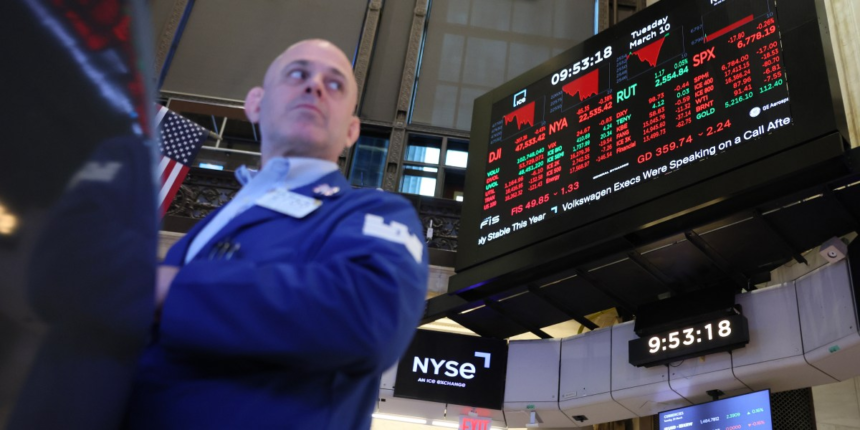
So I check frequently with Arnott to get his take on what those buying into the S&P 500, or baskets of big-cap U.S. stocks, are likely to reap in the years ahead. It’s an especially good time to get a sober reading. The S&P has dropped 4.4% from its record close in January, and the Iran war and jump in oil prices and Treasury yields following the attack are raising a new cloud of pessimism.
Arnott emphasizes the gap between the historic trends in both profits and valuations, and the S&P’s extraordinary outperformance from mid-March of 2016 through today. Earnings per share waxed at over 11% annually, almost twice their long-term average. The S&P multiple ramped by around one-fifth from the low-20s to roughly 27.5, the current number according to FactSet. “In effect, the big returns were front-loaded by that highly unusual scenario,” says Arnott.
But the high times also foreshadowed today’s downside. Starting at these heights in both metrics, he adds, “has the effect of reducing future returns.” The Wall Street market strategists’ view that anything resembling the last decade’s results are repeatable amounts to a fantasy, declares Arnott. “P/Es don’t always go up without limit,” he says. “In no sensible world is that plausible.” Arnott contends that it’s equally illogical to argue that EPS can keep advancing five points or so faster than their long-term average. As everyone from Warren Buffett to Milton Friedman has pointed out, profits can’t outgrow the economy forever, and after they absorb an unusually large portion of national income, shrink back toward the norm going forward.
All told, the overall S&P 500 should then deliver total annual returns of 3.1% (6.5% from dividends and growth, minus 3.4% from a decline in the P/E). That’s one-fifth the mark for the past decade, and exactly one point better than projected inflation of 2.4%. By 2036, the S&P would stand at 8073, just 21% above its reading of 6672 at the close on March 12.
To gauge just how hugely this outlook diverges from the conventional wisdom, consider that the Wall Street consensus calls for the S&P to end this year at between 7600 and 7650, or less than 6% short of where RA expects the index to finish 10 years hence.
Arnott also highlights a significant difference in prospects between the S&P value and growth contingents. The RA model predicts 4% annual gains in the former and a shockingly puny 1.4% in the latter, meaning the recent champs’ returns will lag inflation by one percentage point. Much of the drag, he says, arises from the big valuations, on top of earnings so gigantic they’ll be hard to grow big from here. A major reason we saw that double-digit EPS boom rampage, he avows, “is the stupendous growth in the Mag Seven.” Now, he adds, “Valuations for growth stocks are very stretched, driven by the Mag Seven. The market’s saying it’s a foregone conclusion they’ll grow earnings like crazy. But to beat the market, they’d need to grow earnings even faster than those lofty expectations.”
Arnott’s especially skeptical of the premium prices awarded by investors expecting fantastic profits from AI. “The companies making money from AI are the ones selling the tools,” he says. “They’re now lending to their own customers so that those customers can keep buying their stuff. And their customers are having a hard time monetizing that equipment.” Arnott related that he’d just used Perplexity to perform an in-depth study of how various tax increases being proposed would affect marginal rates at different income levels, and paid nothing for the service. “These AI providers will figure out how to make money,” he says. “But not as fast as the expectations that are built into their stock prices. It will be a slow build over a long period, meaning returns on these stocks will be much lower than the market’s baked in.”
Here’s his advice: “If you’ve owned the Mag Seven, say ‘Thank you very much, Mag Seven,’ and get out and don’t ride them back down.” Arnott believes that returns will be much bigger outside the U.S. than stateside. For example, RA posits that developed nation, non-U.S. value stocks will provide 7.4% returns going forward, more than twice the expectation from the S&P 500, and that emerging-markets value shares will do even better at 7.6%. Arnott concludes that the best strategy is to “first, own no U.S. shares or at least lighten up, and second, own no growth stocks anywhere.”
Versus what we’re hearing from Wall Street, and the S&P’s spectacular showing over the past decade, Arnott’s perception is highly contrarian. But the math’s on his side. And when the math contradicts belief and momentum, go with the math.