Southeast Asia’s start-up scene is just getting started.
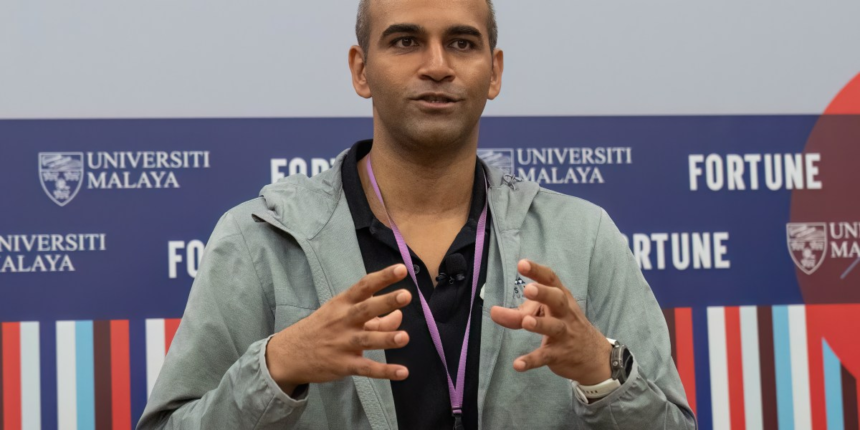
As Arun Pai, a principal at Singapore-based Monk’s Hill Ventures pointed out at last week’s Fortune Innovation Forum in Kuala Lumpur, the region’s tech sector is a decade younger than India’s, two decades behind China, and five decades behind Silicon Valley.
Then there’s the fact that most Southeast Asian economies are still in a very early stage of development. “Countries like Indonesia and Vietnam have very low GDP per capita, which means the willingness to buy your product or service is still extremely challenging [and low],” Pai said on a panel hosted by Universiti Malaya on Nov. 17.
Instead, Pai noted that some Southeast Asian founders, particularly those based in Singapore and Malaysia, were finding success in “building for the globe,” rather than targeting neighboring markets.
Co-panelist Yiannis Maos, co-founder of Unloq AI and one of the driving forces behind turning the UK’s West Midlands region into a tech hub, also suggested that founders take a global perspective.
“If the investment doesn’t exist in your region, look elsewhere—[that] would be my message to start-ups,” he said.
Despite some hiccups in the short-term, Pai said he was “quite confident that things will work out quite well here in the long run.”
Alex Shih, the vice-president of product at Q-CTRL, a quantum infrastructure software company, added that partnerships between academia, industry and government are key to building out technologies like quantum computing.
“It’s great to publish a paper within a lab, but there needs to be some cooperation with the private sector, as well as public funding, to validate the technology [and] scale it up,” said Shih. “Global multinational cooperation is what really allows what would just be scientific demonstrations to scale and become commercialized products,” he added.
“We are starting to see that in Southeast Asia, where you have [people like] Anthony Tan of Grab, who have scaled up their companies and taken them public.”