Senate Democratic Leader Chuck Schumer said Tuesday that after Trump’s “temper tantrum” eased, it appears “things are getting back on track.”
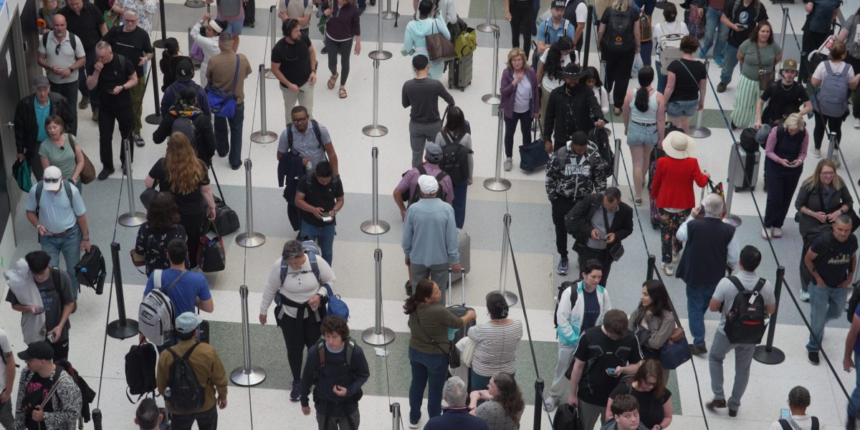
At Philadelphia International Airport, several ICE agents were in the terminals. A protester was also at one of the checkpoints holding a sign criticizing ICE.
Airport wait times listed in the MyTSA mobile app and other public sources may be outdated because the agency isn’t actively updating its websites during the shutdown.
Next steps in Congress could move quickly, if lawmakers can reach agreement, or sputter out just as fast.
The contours of the deal under consideration would fund most of Homeland Security, but not one main part of ICE — the enforcement and removal operations that are core to Trump’s deportation agenda.
Under the proposal being floated, ICE’s Homeland Security Investigations would be funded as well as Customs and Border Protection. But that would come with guardrails — keeping officers from those divisions in their traditional roles, rather than deploying them in urban immigration roundups.
The plan would also include a number of changes in immigration operations that Democrats have demanded, including mandating that officers wear body cameras and identification. While the ICE officers manning airports are going without face-covering masks, the Democratic demand that they go unmasked during immigration operations does not appear to be part of the deal.
Republican Sen. Katie Britt of Alabama, a chief negotiator, returned from the White House meeting hopeful they had a solution to “land this plane.”
Both chambers of Congress are controlled by the Republican president’s party, and any deal reached in the Senate would also have to be approved by the House.
Over the weekend Trump injected his demand for the voting bill as a condition for ending the funding standoff. Some GOP senators have pitched the idea of tackling it in the months ahead as part of a broader legislative package the party could pass on its own, similar to last year’s big tax cuts bill.
The White House on Tuesday stressed that conversations were ongoing. But it also said an agreement to split off immigration enforcement funding, while addressing Trump’s elections bill separately, “seems to be acceptable.”
Sen. Chris Coons, D-Del., who was not part of the group at the White House, said his understanding was that there was a “sense of urgency” coming from the talks as the airport disruptions worsen.
Senators are expected to discuss the proposals during their private caucus lunches Tuesday afternoon.
“First step is to get the proposal in writing,” said Sen. Angus King, an Independent from Maine. “I want to see exactly what that means.”
The deal could provide a political exit from the standoff over the embattled Homeland Security department, which was stood up in the aftermath of the Sept. 11, 2001 attacks but has come to symbolize Trump’s aggressive mass deportation agenda, with its goal of removing 1 million immigrants this year.
Mullin, an Oklahoma senator who aligns with Trump’s agenda, provides a potentially new face for the department. During his confirmation hearing, Mullin touched on another key demand of Democrats — ensuring a judge has signed off on warrants that immigration officers use to search people’s homes, rather than simply relying on administrative warrants issued by the department.
“This is significant,” Sen. Peter Welch, D-Vt., said about the progress toward changes. “Noem is gone. That’s a big deal.”
ICE’s budget grew under last year’s bill by $75 billion, which has been untouched by the shutdown. Rather its routine annual funding, some $10 billion, would be cut almost in half under the proposal.
___
Associated Press writers Rio Yamat, Wyatte Grantham-Philips, Kevin Freking and Seung Min Kim contributed to this report.