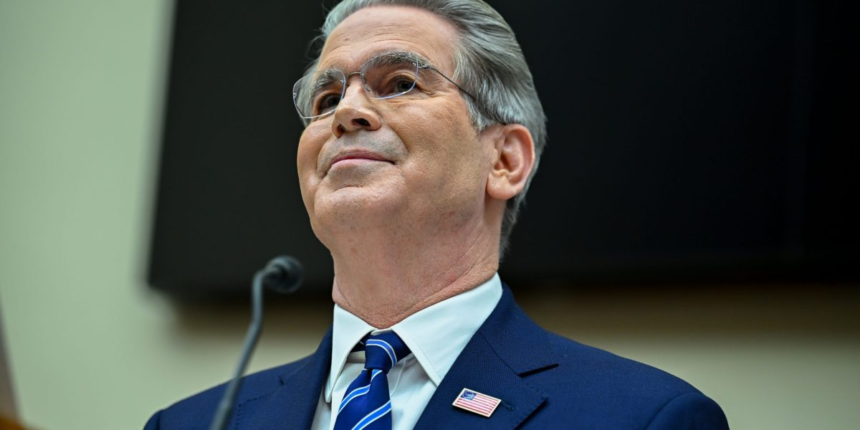
A House Financial Services Committee hearing descended into chaos and personal invective on Tuesday as Treasury Secretary Scott Bessent clashed with ranking member Maxine Waters (D-Calif.) over the economic impact of President Trump’s tariff policies. The heated exchange, ostensibly about inflation and housing costs, culminated in a tense standoff where Waters repeatedly silenced the secretary, telling him, “You don’t get to talk,” and questioning his dignity as he attempted to interrupt her line of questioning.
Undeterred, Waters pointed to a New York Times article citing Bessent’s testimony before a Senate committee the previous summer, in which he allegedly claimed: “There is no inflation; tariffs are not being passed on to consumers,” and dismissed critics as suffering from “tariff derangement syndrome.” Waters sought to clarify the secretary’s current stance, asking plainly whether tariffs drive up costs. Bessent pushed back, citing the San Francisco Federal Reserve and “150 years of data” to argue that “tariffs do not cause inflation.” In this regard, he was relying on historical research showing that tariffs are a relatively small share of GDP and that many large inflation episodes were driven by wars, oil shocks, or monetary policy rather than trade barriers, so the macroeconomic impact often looks small even when particular goods become more expensive.
“Mr. Secretary, why was that announcement even necessary if tariffs aren’t inflationary?” Waters asked, challenging the “Trump logic” that tariffs are paid solely by foreign nations. “A tariff on coffee or bananas shouldn’t raise the price of either for American consumers … But that isn’t reality. It did raise prices across the board.” Waters argued that levying tariffs on goods the U.S. does not produce only serves to “punish the American consumer.”
The tension in the room spiked when the discussion shifted to the housing crisis. Waters accused the Trump administration of exacerbating affordability issues by levying tariffs on critical construction materials like lumber, steel, and appliances. She asserted that these policies would result in “half a million fewer homes built at a time when we need more homes built, not less.”
As Waters spoke, Bessent attempted to interject, noting that lumber was trading at a five-year low. Lumber futures are not, in fact, at a five-year low, priced at $589.50, versus a price of $469 in January 2023.
Bessent’s interruption triggered an immediate and sharp rebuke from the ranking member. “Reclaiming my time. You don’t get to talk,” Waters declared, refusing to yield the floor. As Bessent continued to speak over her, attempting to pivot the blame for the housing shortage to “massed immigration” and the “10 million immigrants” admitted into the country, Waters’ patience visibly disintegrated.
“Can you maintain some level of dignity?” Waters snapped as the two spoke over each other.
The committee chair eventually intervened, stating that the “gentlewoman’s time has expired,” though Waters protested that the secretary had consumed her time with his interruptions.
In the current research landscape, the weight of evidence supports the conclusion that Trump’s tariffs have been modestly but clearly inflationary at both the goods and aggregate levels, even if they are not the primary driver of overall inflation. The hearing dramatizes that tension: Bessent is effectively arguing that “modest” equals “irrelevant,” whereas Waters is stressing that for families squeezed by housing and groceries, the tariff‑driven portion of inflation is politically and materially significant.