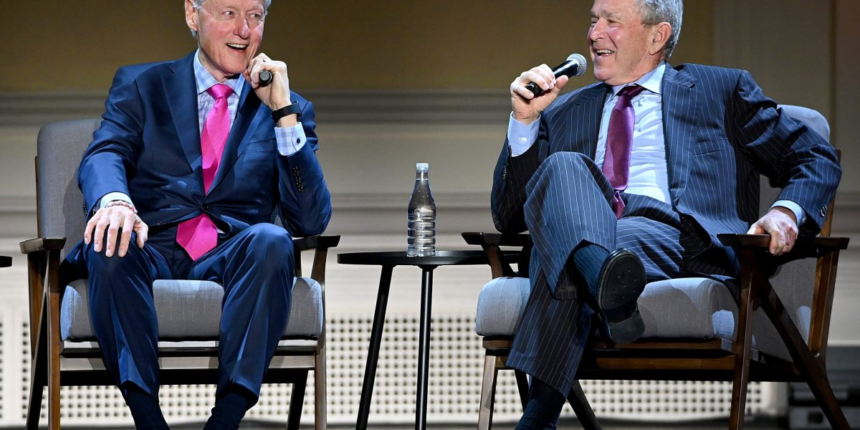
For Clinton, the exchange reflected a broader principle that applies far beyond politics: Success often comes down to learning from people who think differently—and getting out of your own way.
“You’ve got to cultivate people who know things you don’t and have skills you don’t—and yes, that can be taught,” Clinton added.
“If nothing else, we can help people get out of their own way. Everybody’s got a story and a dream, and they can bring it to bear if we can just help people get out of their own way sometimes.”
While both Bush and Clinton are now remembered as two-term presidents, neither mapped out a straight line to the Oval Office in their youth. Like most careers, theirs were shaped as much by setbacks and detours as by ambition.
According to Bush, rigid life plans can actually do more harm than good.
“I think you ought to be open-minded as to where life takes you. One of the things I learned as president is that your life is just not going to unfold the way you want it to. There will be surprises, challenges, and therefore the question is how you deal with the unexpected.”
Clinton’s own path tells a similar story. Before the White House, he lost his first ever political race when he ran for Congress in the 1970s. Instead of letting the defeat define him, he regrouped—later winning elections as Arkansas attorney general, then governor, and eventually president.
The same dynamic plays out far beyond politics. The idea of learning from rivals—and keeping strong relationships even in competitive environments—is just as common in the business world.
Gates has long embraced a leadership truth that mirrors the Bush–Clinton dynamic: Progress often depends on being open to perspectives outside your own camp.