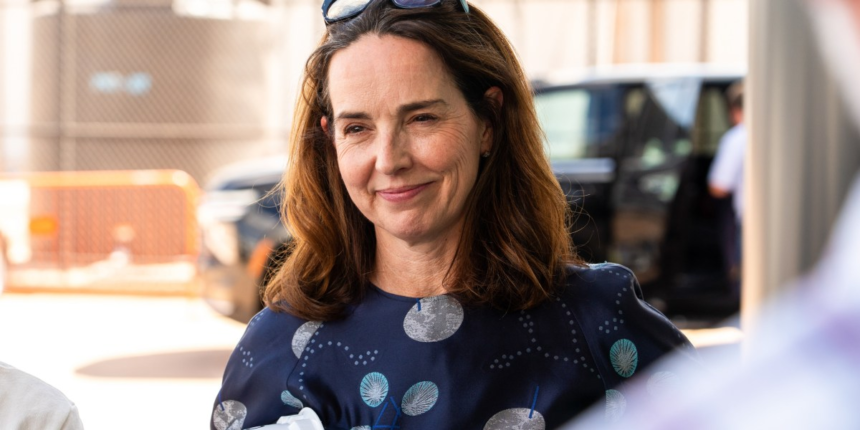
Artificial intelligence is now being treated as core economic infrastructure, and OpenAI CFO Sarah Friar says most organizations are barely scratching the surface of what it can do.
OpenAI’s finance chief since June 2024, Friar highlighted “capability overhang” as a concept that kept resurfacing at Davos—the gap between what AI can already do and the value organizations actually capture. According to Friar, there is a mismatch between today’s powerful AI capabilities and the relatively shallow way most people and companies use them, with advanced tools still only lightly integrated into real workflows and decision-making.
“Experience and execution are closing that gap faster than any amount of rhetoric,” she writes. “At OpenAI, we see that frontier users use seven times the amount of intelligence than the average user—they’re going deep on coding, deep research, and pushing the models to really be thought partners.”
In essence, some countries are already using AI to tackle harder problems and move faster, regardless of their resources. These early adopters are seeing real productivity gains—their workers can focus on more complex work, new products and services, and accelerate innovation in ways that drive economic growth and improve living standards, OpenAI finds.
Another moment that resonated with Friar in Davos was the WEF CFO gathering, which “reinforced how pragmatic finance leaders are,” she writes, adding that there’s “broad conviction that AI is inevitable, but deployment hinges on ROI, clean data, and simpler systems; this is a change-management challenge, not a belief gap.”
This revenue growth closely tracked an expansion in computing capacity. OpenAI’s computing capacity rose from 0.2 gigawatts (GW) in 2023 to 0.6 GW in 2024 and about 1.9 GW in 2025.
The company’s strategy of combining infrastructure expansion with practical, domain-specific applications reflects the pragmatic approach to AI deployment that Friar observed among finance leaders in Davos.